The folks at UNESCO have notified me that an official reply is being drafted to the petition that calls on them to discontinue adding further monuments from Azerbaijan to the World Heritage List until Baku acknowledges and punished the destruction of the world’s largest medieval Armenian cemetery, Djulfa, which was reconfirmed by the American Association for the Advancement of Science satellite study last month.
“Who controls the past controls the future;” party slogan states in George Orwell’s dystopian novel 1984, “Who controls the present controls the past.”
While hopes are high that – despite a hostile history – Armenia and Turkey will establish diplomatic relations and that the Nagorno-Karabakh conflict between Armenia and Azerbaijan may finally be solved, the problem of how to deal with the official Turkish/Azerbaijani factory of history is not being addressed.
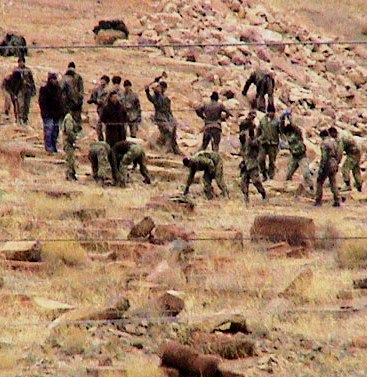
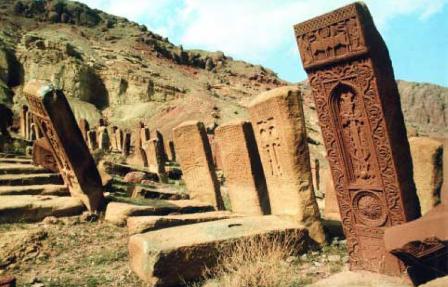
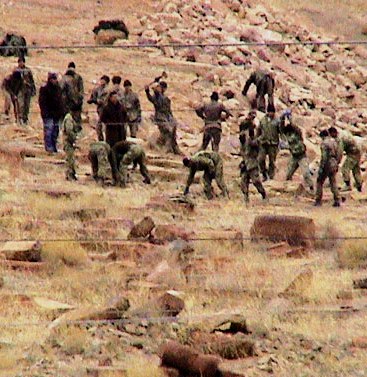
Djulfa, Nakhichevan: the worst documented case of history fabrication; Azerbaijani soldiers destroying the largest Armenian medieval cemetery in the world (December 2005) – the site is now a military rifle range
It’s not merely Turkey’s and Azerbaijan’s denial of the Armenian Genocide that makes the reconciliation quite difficult, to say the least, but also the official Turkish thesis, with its roots in the Young Turkish movement (that carried out the Armenian Genocide) and formalized by Ataturk, that Turks/Azeris are indigenous to their current homelands and that Armenians, in the best case, are unwelcome immigrants.
While the Turkish fabrication of history can be dismissed as an issue of “internal consumption” – meaning a convenient myth to boost Turkish/Azeri pride in their respective countries (with the dangerous slogan “Happy is the man who can say I am Turk”) – the implications of flip-flopping history are right there in the middle of the current developments in the region. Here is a most recent case.
Turkey’s ceremonial president Abdullah Gul is currently visiting Nakhichevan (or Nakhchivan as Azerbaijan prefers), the region of Azerbaijan which it got from the communist regime in Moscow as another gift at the expense of giving out Armenian lands. Moreover, a treaty that Soviet Armenia was forced to sign from Moscow made Turkey the “guarantor” of Nakhichevan in the 1920s.
Gul is visiting Nakhichevan with other heads of “Turkic-speaking countries” (most of them in Central Asia) to talk about common issues. Sounds like a normal political event, and nothing to protest about, especially since Armenia has no official claims toward Nakhichevan. But read the rest.
As there are no Armenians left in Nakhichevan (thanks to a Soviet Azerbaijani policy of nonviolent ethnic cleansing which attracted little attention at the time) and not a trace of the rich Armenian heritage (the most precious of which, the Djulfa cemetery, was reduced to dust by Azeri soldiers in December 2005 – see the videotape), Armenia has no claims to Nakhichevan and perhaps rightly so. Yet, apparently, the history factory in Nakhichevan is still cooking.
While Armenia restraints itself from claiming its indigenous lands, and particularly Nakhichevan, taken away from it without its consent, Turkey and Azerbaijan must discontinue their unhealthy fabrications of history. Instead…
Putting the “native” side aside for a moment, the distortion of not just basic history but of linguistics is sickening. Save for the disputed proposal that Nakhichevan comes from the Persian phrase Naqsh-e-Jahan (image of the world), every other explanation of the name of the region has to do with Armenians (see Wikipedia for the several versions), let alone that the word itself has two Armenian parts to it: Nakh (before or first) and ichevan (landing, sanctuary) – referring to Noah’s coming out of the Ark from (another holy Armenian symbol) Mount Ararat – next to Nakhichevan now on Turkish territory.
Ironically, and as almost always in history fabrication, the Azeri/Turkish distortion of “Nakhichevan” is inconsistent. According to an official Azerbaijani news website, there are discussions in Nakhichevan that admit that the word has to do something with Noah (of course after saying that it had to do with a mythical Turkish tribe that lived there thousands of years ago): “The Turkic tribes of nakhch were once considered as having given the name to it. Other sources connect Nakhichevan with the prophet Noah himself, as his name sounds as nukh in Turkic.” Moreover, as an official Nakhichevani publication reads, “There is no other territory on the earth so rich with place-names connected with Noah as Nakhichevan. According to popular belief, Noah is buried in southern part of Nakhichevan, and his sister is buried in the northwest of the city.” Hold on. Did you notice that the language uses (at least its official English translation) the Armenian taboo name of the region: Nakhichevan (as opposed to Turkified Nakchivan)? Maybe there is hope, but not really. Azerbaijan still denies that it didn’t destroy the Djulfa cemetery because, well, it didn’t exist in the first place.
A skeptic would ask what the fuss is about. The answer is that Nakhichevan’s distortion is not the first. The sacred Armenian places of Ani, Van, and Akhtamar in Turkey all have official Turkish explanations to their meanings, while those places existed for hundreds – if not thousands – of more years before Turks colonized the homeland of the Armenians.
More importantly, the changing of toponyms is not done to meet the social demands of Turks/Azeris and in order to make it easier for the locals to pronounce geographic names. Distortion is done to rewrite history in order to control the future. But it’s not the right thing to do. And both Turkey and Azerbaijan embarrass themselves when it comes to legal discussions.
Immediately prior to voting for the Declaration on the Rights of Indigenous Peoples in September 2007, for example, the Turkish delegation at the United Nations made it clear that its “yes” vote was cast with the understanding that there were no indigenous peoples on Turkey’s territory. If there were indigenous peoples on the territory, the Turkish representative stated, then the declaration didn’t challenge states’ territorial integrity. Azerbaijan, on the other hand, abstained from voting.
The reservation on the UN document came from both countries who claim that there are the indigenous heirs of the lands they occupy and that their main enemy, Armenians (and also Kurds) are not only indigenous but are recent immigrants.
One version of Azerbaijan’s ridiculous inidigenousness claim is written on the website of one Azerbaijani Embassy: “The ancient states of Azerbaijan, which maintained political, economic and cultural ties with Sumer and Akkad and formed part of the wider civilization of Mesopotamia, were governed by dynasties of Turkic descent. The Turkophone peoples that have inhabited the area of Azerbaijan since ancient times were fire-worshippers and adherents of one of the world’s oldest religions – Zoroastrianism.”
Armenians (and to a large extent the Kurds, Assyrians and Pontiac Greeks) have their share of fault in the debate. Constantly repeating their indigenousness in what is now Turkey and Azerbaijan, Armenians have helped create the defensive Turkish/Azeri attitude that they, and not Armenians or others, are the indigenous peoples of the land. But when it comes to fabricating history of their own, there is little blame for Armenia.
As Armenia struggles to defend the victory it won over the Karabakh conflict, most Armenians use the Turko-Persian name for Nagorno-Karabakh (Karabakh meaning black garden, Kara – black in Turkish and bagh – garden in Farsi). While some Armenian nationalists prefer using the indigenous name of the region, Artsakh, many others indirectly admit that diverse history of Nagorno-Karabakh by keeping its Turkified name.
While Turkey ad Azerbaijan must come to terms with history, Armenia must accept that Turks and Azeris are there to stay. All the nations in the region have equal rights to existence, but not so at the unhealthy price of fabricating history.
Assyrians around the world are protesting what they consider to be Turkey’s attempt to oppress and eventually close the oldest surviving Syriac Orthodox church on Earth.
Mor Gabriel Monastery, founded in 397, has survived centuries of oppression, including the World War I genocide against indigenous Assyrians and Armenians by Ottoman Turkey. Its remote location, perhaps, is one reason.
But with rising Turkish nationalism – and increasing Assyrian demands for recognition of their genocide – Mor Gabriel Monastery is facing challenges. In the words of a Turkish newspaper:
[…]
A local prosecutor in August 2008 initiated a separate court case against the monastery after mayors of three villages complained the monks were engaged in “anti-Turkish activities” and alleged they were illegally converting children to the Christian faith. Monks say the mayors are instigating anti-Christian feelings by accusing Mor Gabriel of being against Islam. Villagers in neighboring Çandarlı, a settlement of 12 humble houses with no paved roads, said they had nothing against Christians and accused the monastery of taking land they need for cattle.
“There is a continued campaign to destroy the backbone of the Syriac people and close down the monastery,” said Daniel Gabriel, director of the human rights division of the Syriac Universal Alliance, a leading Syriac group based in Sweden. “These proceedings cannot take place without the sanction of the Turkish government. If the government wanted to protect the Syriac Christian community, it would stop this case,” he said.
Many churches and monasteries in southeast Turkey — known to Syriac Christians as Turabdin or “the mountain of worshippers” — are now abandoned and in ruins. “You need people to have a church. Without the community, the church is only a building,” said Saliba Özmen, the metropolitan, or bishop, of the nearby city of Mardin.
Five months after the war with Russia over South Ossetia, Georgian authorities have reportedly arrested two members of its Armenian minority on suspicion of espionage and forming an armed gang. Underrepresented in the local government of a region where they make up the majority, some Armenian demands for autonomy of Georgia’s Samtskhe-Javakheti region (map) are once again being heard.
Realarmeniaposts an announcement by an Armenian organization in Georgia, detailing the charges:
On January 22, 2009 the special forces of the Ministry of Internal Affairs of Georgia detained Grigor Minasyan, the director of the Akhaltskha Armenian Youth Center of Samtskhe-Javakheti Region of Georgia and Sargis Hakobjanyan, the chairman of “Charles Aznavour” charitable organization. They were charged with “preparation of crime”, according to Article 18 of the Criminal Code of Georgia, and “formation or leading of a paramilitary unit” (Part 1 of Article 223) and “espionage” (Part 1 of Article 314).
The announcement also reads:
The «Yerkir» Union considers these arrests as a deliberate provocation by the Georgian authorities, aimed at deterioration of the situation in the Samtskhe-Javakheti region and worsening the Armenian-Georgian relations…Only a democratic Georgia, respecting its ethnic diversity, can avoid further disruption and guarantee the sustainable development of the country.
While XUSSR NEWSreminds of earlier arrests of ethnic Armenians in Georgia, there is little information in the conventional media about the new development and limited discussion in the blogosphere.
Nevertheless, The Caucasian Knot is concerned by the latest developments, and particularly by what is considers nationalist statements made by some in Armenia suggesting for Javakheti’s independence from Georgia.
[Think-tank] Mitq […] continues to play the nationalist card by warning of a second Armenian Genocide [in Georgia]. The same news site carries a report quoting a former Armenian Ambassador who not only lays claim to the region, but potentially risks encouraging a new armed conflict.
[…]
And as Armenian nationalists openly boast that “after Karabakh, Javakhk is next,” more diplomatic initiatives and sensitive handling by both Yerevan and Tbilisi seems more necessary than ever.
The blog, nonetheless, acknowledges problems in the region and especially with Council of Europe demands to repatriate Meskhetian Turks deported from the region by Stalin in 1944. Other bloggers in Armenia staged a mock funeral in 2008 outside the Georgian Embassy in protest at an ongoing dispute over church property in the Georgian capital, Tbilisi.
As an indication of some concerns that Armenians have about the level of cultural rights in Georgia, smbatgogyan [AM] has detailed an Armenian textbook published in Georgia with countless typos and grammatical errors.
Գնացել էի գյուղ, որը գտնվում է Վրաստանում` Ջավախքում: Այնտեղ արդեն մի-քանի տարի է, ինչ դպրոցներում փորձում են վերացնել հայերենը: Սակայն նրանց մոտ ոչինչ չստացվեց` ծնողները հրաժարվեցին իրենց երեխաներին քիմիա, աշխարհագրություն և համաշխարհային պատմություն սովորեցնել վրացերենով: …Վրաստանի կրթության նախարարությունը սկսել է հայերեն լեզվով դասագրքեր տպել Վրաստանի հայկական դպրոցների համար և պարտադրում է ուսանել այդ գրքերով: Ահա այդ գրքերից մեկը…:
…I went to a village in Georgia’s Javakhk [region]. [The Georgian authorities] have been trying to eliminate the Armenian language at schools there. But they were unsuccessful: parents refused to let their children learn chemistry, geography and world history in Georgian…. Georgia’s ministry of education has started to print textbooks in Armenian and requires to use them at school [as opposed to textbooks published in Armenia]. Here is one of those books…
The blog posts the cover of a mathematics textbook for second-grade students with the large title containing two typos in the word “mathematics.”
Interestingly, an earlier post dealt with translating textbooks into minority languages in Georgia. Writing for TOL Chalkboard, Swiss-Armenian journalist and regional analyst Vicken Cheterian detailed the project.
When we […] carried out bilingual education studies in Georgia […] we wondered how the images of minorities were reflected in the pages of Georgian history textbooks[…].
Their report […] found something startling: Armenians and Azeris in Georgia were by and large absent from Georgian history books. When they were noted, it was in a negative sense.
[…]
A workshop held in November [2008] […] concluded that the Georgian Education Ministry is moving forward in its efforts to change the way history is taught. At the event […] Georgian educators presented their ongoing project to develop new textbooks with the aim of giving more space to minorities in the official version of history presented to youngsters from majority and minority linguistic communities.
These new texts should begin appearing soon in Armenian and Azeri schools, and be in use in all history classes in Samtskhe-Javakheti and Kvemo-Kartli by 2011.
[…]Georgian history teachers and authors are moving from a position of negation of ethnic minorities to one of recognition. But important obstacles remain in the path toward an integrated narrative of history in which minorities move from being the “other” coexisting with “us” into being part of society.
…[I]n a turbulent political climate following the catastrophic August war [with Russia], Georgian education authorities and many educators continue to press for change.
Will the process of “change” include enough Armenians and Azeris so that relations, let alone words, are not lost in translation?
Three years after a cemetery dating back to the 9th Century was deliberately destroyed in the Azerbaijani exclave of Nakhichevan, bloggers recall an ancient culture annihilated and condemn the world for closing its eyes to what many consider to be an official attempt to rewrite history.
Today is the commemoration of the 3rd anniversary of Djulfa’s destruction. …This [is] not only a crime against Armenian culture, but against our collective cultural heritage as humankind. Don’t let it go unnoticed.
Between 10-16 December 2005 over a hundred uniformed men were videotaped destroying the Djulfa cemetery using sledgehammers, cranes, and trucks. The video was taken from across the border in Iran.
Азербайджанские власти на протяжении всего советского периода старались уничтожить этот некрополь, поскольку для них он был всего лишь свидетельством о том, что именно армяне были хозяевами этой территории на протяжении веков, вопреки тому, что говорилось в азербайджанских советских мифах о собственной “древности”… Это кладбище, вполне достойное названия чуда, было даже не внесено в реестр архитектурных памятников Азербайджана… После распада СССР, во время карабахского конфликта, продолжалось разорение кладбища, и, наконец, оно было окончательно уничтожено….
The Azeri authorities throughout all Soviet period tried to destroy this necropolis as for them it was only a testament that Armenians were owners of this territory throughout centuries in spite of Azerbaijan’s Soviet myths about own “antiquity”… This cemetery, quite worthy to be called a wonder, was not even placed on the register of architectural monuments of Azerbaijan… After USSR’s collapse, during the Karabakh conflict, the cemetery’s demolition continued, and, at last, definitively destroyed….
آنان از سنگ قبر ارامنه هم نگذشته اند و با تخریب دوازده هزار قبر با سنگ قبر هایی منحصر به فرد که متعلق به چند قرن پیش بوده و جزئی از میراث فرهنگی ارامنه به حساب می آمد، هیچ اثری از ارمنی نشین بودن آنجا، بجا نگذاشته اند.
[After acquiring Nakhichevan, Azeris] did not even tolerate Armenian gravestones. They destroyed twelve thousand Armenian graves. These unique gravestones with several centuries’ history were part of Armenian cultural heritage. However, through destruction of these gravestones, [Azeris] destroyed all signs indicating the existence of Armenians in that land. [translated by Loosineh M.]
iArarat, remembers Djulfa by discussing Robert Bevan’s The Destruction of Memory: Architecture at War, a book that was “part of a class I teach at a Texas university on nationalism and ethno-political conflicts.”
[…]
While reading Bevan’s book I was inevitably reminded of the destruction of the medieval Armenian cemetery in Jugha, presently in Azerbaijan. Azeri soldiers at the command of their superiors without as much as blinking an eye would embark at destroying and erasing the last vestige of the Armenian civilization in that territory as if the Armenians had never as much as existed there, as if Armenians had never as much as created anything, something to celebrate their faith and commemorate their dead…
Adding insult to injury, earlier this month Baku, Azerbaijan hosted a little-noticed two-day conference of Council of Europe culture ministers to discuss “Intercultural dialogue as the basis for peace and sustainable development in Europe and its neighboring regions.” In his opening remarks to the attendees Azeri president Ilham Aliyev, astonishingly claimed:
“Azerbaijan has rich history and the cultural monuments here are duly preserved, and a lot is being done in this direction…”
Meanwhile, nrbakert_tashuk [Ru] asks whether one should laugh or cry at attempts to represent other indigenous Armenian monuments as Turkish or Azerbaijani. However, Kornelij [RU] says Armenia is also to blame for not participating in a conference held early this month in the Azerbaijan capital, Baku.
[T]he Armenian Ministry of Culture failed to deliver a message by boycotting the conference. They either should have properly boycotted the conference by making an appropriate statement explaining the reasons for non-participation, or they should have participated there to raise the all important issues of destruction of Armenian cultural heritage in Azerbaijan, as well as protecting and restoring the multinational cultural heritage in all three South Caucasus countries [Armenia, Georgia, and Azerbaijan].
old-dilettante [RU], says that Djulfa’s destruction was the last stage of Azerbaijan’s attempt to eradicate Nakhichevan’s Armenian heritage. Commenting on a post about churches in Georgia, she writes:
Теперь там не найдется ни одной армянской церкви, несмотря на фотографии и книги, изданные всего ничего – лет 20 тому назад. Все церкви уничтожены. Все могилы. Все хачкары.
И кто через 20 лет скажет, что там вообще жили армяне? … А ведь мой дед был “местным жителем”.
…Now, not a single Armenian church will be found [in Nakhichevan] despite of photographs, some as recent as 20-years-old. All churches are annihilated. All cemeteries. All khatchkars.
And who will say in 20 years that Armenians ever lived there? … It wasn’t that long ago that my own grandfather was a “local” there.
Also recalling family history, Washington-based Armenian journalist Emil Sanamyan, a native of Azerbaijan’s capital Baku, commemorates the destruction of Djulfa.
In Baku Armenian cemeteries with less historical but more immediate sentimental value to many (including my family whose three generations made their home in Baku for nearly a century) were paved over for roads or new construction. That does not justify the disrespect they were afforded but makes some remote sense.
In the case of Jugha khachkars stood in the middle of nowhere and were simply crushed, dismembered, thrown into the river. They were targeted and wiped out as the last remaining Armenian outpost.
Sarcastically, the journalist-blogger considers how other Armenian monuments on Azerbaijani territory could be protected.
Now I am thinking, perhaps Armenians should disassemble the remaining Azeri mosques and gravestones on their territory and exchange them for the khachkars and other Armenian heritage items of value?
Certainly some of the Azeri items have cultural value for Armenia and I would rather not see them go. But what other options are there?
Reacting to a comment on his above-mentioned post, Ivan Kondratiev [RU] also says that if Azerbaijanis wanted to cleanse their territory of Armenian heritage, they could have at least given the monuments to Armenia even if such a transfer would amount to acknowledging Djulfa’s Armenian history.
Is the world willing to confront deliberate destruction of historic monuments? In her long post on Djulfa’s destruction, The Stilettosees hope in an Obama administration.
[T]here is reason to be optimistic that [Barack Obama’s] foreign policy team will… have a very different response to the ongoing stonewalling by the Azeris than [current US Secretary of State] Rice’s utter disinterest [about Djulfa’s destruction], which is rooted in the Bush administration’s pro-Azerbaijani, pro-Turkey foreign policy.
In addition to secretary of state nominee Hillary Clinton […] prospective U.N. Ambassador Susan Rice has a particular interest in genocide and is an advocate of military action to stop mass killings, rather than ineffective “dialogue” as slaughters continue apace. And Harvard professor Samantha Power, author of “A Problem from Hell: America and the Age of Genocide” (2002), has been quietly advising Obama behind the scenes […].
Given that past is prologue, with these women’s combined emphasis on championing human rights and genocide prevention, it will not be easy for the Obama administration to ignore or overlook the genocide that preceeded – and encouraged – all others in the 20th and 21st centuries, or the ongoing “cultural genocides” in Azerbaijan and Turkey against the archeological remains of a once-thriving, centuries-old Armenian population that is no more.
More photographs of the cemetery, before and after its destruction, are available at www.djulfa.com.
Balkan Travellers has a wonderful article on the ancient Armenian city of Ani, today in Turkish territory, attempting to explain in words a world that can only be experienced:
We pass by Ocakli, the last Turkish village before the border with Armenia. The mythical Armenian capital Ani, which at the end of the ninth century outshined Constantinople, Cairo, and Baghdad with its splendour, lies somewhere before us. Chronicles called it “City of 1,001 Churches” and a replica of Istanbul’s Saint Sophia used to stand in its centre.
[…]
ow only a few tumbledown churches, some sections of a castle and Marco Polo’s bridge remain from what used to be a magnificent city. In some places the double city wall rises and culminates in turrets of various shapes and heights, in others it goes down, sometimes completely disappearing in the tall grass.
We take a broad dusty road, which meanders between the ruins.
Armenian architecture is one of civilization’s greatest enigmas. It has its own unique appearance, but more importantly – it forms the basis of a popular European medieval phenomenon, known as Gothic style. According to Joseph Strzygowski, who wrote in the early twentieth century, Armenian engineers were the first to devise a way to put a round dome over a square space. They did this in two ways: either by transforming the square into a triangle or by building an octagonal structure to hold the dome. Their architectural genius resulted in stunningly beautiful buildings.
Two years and a month after the destruction of Djulfa, we are announcing the Djulfa Virtual Memorial and Museum. Here is the first official press release with special thanks to Armen Hovhannisyan from www.Hayastan.com:
Aimed at spreading awareness about cultural cleansing in the Republic of Azerbaijan, a project to document the deliberate destruction of the world’s largest medieval Armenian archaeological site has been launched online.
The Djulfa Virtual Memorial and Museum (www.djulfa.com), announced in January of 2008, claims to be the foremost online resource on the medieval cemetery in old Djulfa (Jugha in Armenian), which was reduced to dust in December of 2005 by a contingent of Azerbaijan’s army. The destruction, videotaped by a film crew at the Iranian-Azerbaijani border, and condemned by the European Parliament, has been denied as “slanderous information” by officials in Azerbaijan.
The newly launched project includes film and reference material on the history and destruction of the Djulfa cemetery. The Photo section features a number of previously unpublished images of the cemetery taken by French-Lithuanian art critique Jurgis Baltrusaitis, who visited the site in 1928. A publication co-authored by Baltrusaitis has also been digitalized and posted on the website.
The Djulfa Virtual Memorial and Museum is maintained by volunteer staff and an advisory board. Learn about the annihilated sacred stones at www.djulfa.com.
Afghanistan’s famed Bamiyan Buddhas, reduced to dust by the Taliban in 2001, may be returning in a few years.
Japanese artist Hiro Yamagata, according to Bamiyan Laser, is working on a project that in June of 2012 will display Buddha images at the site where the sacred monuments were destroyed by Islamic militants.
Over 250 laser systems installed 500m,1km and 5km in distance from the Bamiyan hills will project multiple layers of original Yamagata Buddha images drawn in striking colors.
The laser images will be projected for 1 hour after sundown, 6 days without friday.
The laser systems built specifically for this installation will shoot long range green beams and short range multiple color beams, designed to create a striking contrast to the purplish red hue of the Bamiyan sunset and the black mountain shadows.
The energy used by the laser systems will be produced by environmental friendly windmills and solar power plants. The power produced is also meant to provide light and electricity for the people of Bamiyan.
Although the Buddhas will be visible only at certain times of the year, the project is said to be sustainable and permanent:
The original Bamiyan Buddhas were created approximately 1500 years ago, as one of the most significant historical monuments of mankind.
My artistic concept is to create original images of Buddha and project them with the most unique,powerful and cutting edge laser technology of today onto the site where once the ancient Bamiyan Buddhas stood. Thus we will be able to revive the great creative spirit of mankind which produced the Great Buddha of Bamiyan centuries ago. A collaboration of ancient and new art will become a cultural icon of revived civilization in Afghanistan.
By permanently creating an artwork of laser system installation in Bamiyan, we intend to stimulate both the land and the people of Bamiyan.
But instead of the handful Buddha statues destroyed by the Taliban, the laser project will have 160-240 Buddhas. The figure gives hope that destroyed historic sites with hundreds of monuments can be “recreated” through laser imaging as well. A similar project could be put together to memorialize the largest medieval Armenian cemetery reduced to dust in Azerbaijan in 2005.
What about “recreating” the New York Twin Towers with laser?
Image: UNESCO delegates looking at a new Azerbaijani military camp in September of 2007 where the Djulfa cemetery existed before December of 2005. This site could become the world’s largest laser-powered museum with thousands of recreated tombstones
The cemetery should be recreated – whether on Azeri or Armenian territory – before the 10th anniversary of the destruction of Djulfa. So there is much work to do until 2015. Interestingly, that is also the 100th anniversary of the Armenian Genocide. History repeats?
Discovery of an Armenian written gravestone within the sphere of Soltanieh dome lead to the discovery of a graveyard of Armenians from the Mongolian era by experts of CHTO and Armenian archeologists.
The result of researches revealed the fact that this gravestone is related to Mongolian time, and there is a strong existence possibility of a graveyard near the mentioned sphere.
According to Ghorban Zadeh, discovery of this Armenian graveyard near Abbas Abaad can help to discover the true history of Soltanieh dome.