UNESCO, the organization charged with protecting our global heritage, has finally responded to the December 2010 petition asking it to hold Azerbaijan responsible for deliberately destroying the magnificent medieval Djulfa (Old Jugha) cemetery by officially discontinuing addition of monuments from Azerbaijan to the World Heritage List.
While the UNESCO letter says protection of Armenian heritage is of “constant concern” and acknowledges having received prior inquiries, it beats the same ineffective drum of calling on Azerbaijan to let UNESCO investigate the site of the cemetery – which is tantamount to inaction since Azerbaijan has consistently denied access to the cemetery and will continue to do so. That’s exactly why the American Association for the Advancement of Science used satellite techonology to investigate the destruction.
It is disappointing to see UNESCO unwilling to condemn the destruction of Djulfa, let alone hold Azerbaijan accountable for it. Very disappointing.
The folks at UNESCO have notified me that an official reply is being drafted to the petition that calls on them to discontinue adding further monuments from Azerbaijan to the World Heritage List until Baku acknowledges and punished the destruction of the world’s largest medieval Armenian cemetery, Djulfa, which was reconfirmed by the American Association for the Advancement of Science satellite study last month.
A high-resolution satellite image of a medieval Armenian cemetery in Azerbaijan taken in September 2003 shows hundreds of khachkars, intricate 15th and 16th century burial monuments. In a satellite image from May 2009, however, the khachkars are missing, suggesting that they were either destroyed or removed.
…
“Geospatial images allow us to shed light on regions that are not accessible, providing a visualization tool for events or circumstances that are important to bring to the public’s attention but which, without some visual evidence, are less likely to attract attention and interest,” said Jessica Wyndham, senior project director of the AAAS Science and Human Rights Program.
In September of 2003 (upper data), the central area of the Djulfa graveyard appears to have sustained significant damage, but the areas to the northeast and southwest remain largely intact. By May of 2009 (lower data), however, the entire area has been graded flat, apparently by earthmoving equipment.
A close-up of the southwestern portion of the cemetery clearly shows the extent to which the area has been scoured. Upper data from 2003; lower data from 2009.
The northwestern area of the Djulfa cemetery in Azerbaijan has also been completely demolished. Upper data from 2003; lower data from 2009.
The AAAS team has also put together a video where Susan Wolfinbarger, senior program associate for the Geospatial Technologies and Human Rights Project, a part of the AAAS Science and Human Rights Program, explains their methodology and findings.
While Djulfa’s destruction was until now well-documented, the AAAS study conclusively, scientifically, and objectively confirms what Azerbaijan can no longer deny without ridiculing itself and what UNESCO – the organization charged with protecting our global heritage – can no longer keep silence on without discrediting its mission.
What UNESCO must do is to tell Azerbaijan that the former won’t add any new monuments from the latter to the World Heritage List until Azerbaijan’s authorities acknowledge the destruction at Djulfa and prosecute the perpetrators of this crime against world culture. That’s what the petition at http://www.thepetitionsite.com/takeaction/235/907/968/ demands and I hope that you will take one minute to add your signature to it.
I got word from a friend of mine that his colleague Alexis Hirschhorn, a Belgian consultant, has made a music video commemorating the destruction of Djulfa cemetery in Azerbaijan.
Based on the footage of my The New Tears Araxes film (2006), Hirschhorn says his video is meant “to inform my non-Armenians friends of this tragedy, and on the 1915 Armenian genocide which like the destruction of Djulfa is still denied by its perpetrators. I thought it could have an impact specially now that we are nearing the 5th anniversary of Djulfa’s destruction. Also I think it was interesting for my Armenians friends to see a non-Armenian perspective on this.”
Although written and performed in French, the video has English subtitle with Spanish subtitle to follow soon.
“Who controls the past controls the future;” party slogan states in George Orwell’s dystopian novel 1984, “Who controls the present controls the past.”
While hopes are high that – despite a hostile history – Armenia and Turkey will establish diplomatic relations and that the Nagorno-Karabakh conflict between Armenia and Azerbaijan may finally be solved, the problem of how to deal with the official Turkish/Azerbaijani factory of history is not being addressed.
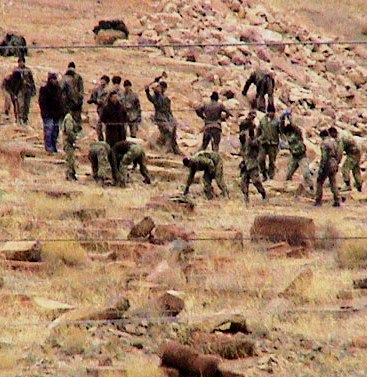
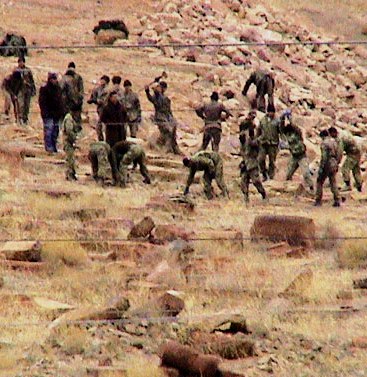
Djulfa, Nakhichevan: the worst documented case of history fabrication; Azerbaijani soldiers destroying the largest Armenian medieval cemetery in the world (December 2005) – the site is now a military rifle range
It’s not merely Turkey’s and Azerbaijan’s denial of the Armenian Genocide that makes the reconciliation quite difficult, to say the least, but also the official Turkish thesis, with its roots in the Young Turkish movement (that carried out the Armenian Genocide) and formalized by Ataturk, that Turks/Azeris are indigenous to their current homelands and that Armenians, in the best case, are unwelcome immigrants.
While the Turkish fabrication of history can be dismissed as an issue of “internal consumption” – meaning a convenient myth to boost Turkish/Azeri pride in their respective countries (with the dangerous slogan “Happy is the man who can say I am Turk”) – the implications of flip-flopping history are right there in the middle of the current developments in the region. Here is a most recent case.
Turkey’s ceremonial president Abdullah Gul is currently visiting Nakhichevan (or Nakhchivan as Azerbaijan prefers), the region of Azerbaijan which it got from the communist regime in Moscow as another gift at the expense of giving out Armenian lands. Moreover, a treaty that Soviet Armenia was forced to sign from Moscow made Turkey the “guarantor” of Nakhichevan in the 1920s.
Gul is visiting Nakhichevan with other heads of “Turkic-speaking countries” (most of them in Central Asia) to talk about common issues. Sounds like a normal political event, and nothing to protest about, especially since Armenia has no official claims toward Nakhichevan. But read the rest.
As there are no Armenians left in Nakhichevan (thanks to a Soviet Azerbaijani policy of nonviolent ethnic cleansing which attracted little attention at the time) and not a trace of the rich Armenian heritage (the most precious of which, the Djulfa cemetery, was reduced to dust by Azeri soldiers in December 2005 – see the videotape), Armenia has no claims to Nakhichevan and perhaps rightly so. Yet, apparently, the history factory in Nakhichevan is still cooking.
While Armenia restraints itself from claiming its indigenous lands, and particularly Nakhichevan, taken away from it without its consent, Turkey and Azerbaijan must discontinue their unhealthy fabrications of history. Instead…
Putting the “native” side aside for a moment, the distortion of not just basic history but of linguistics is sickening. Save for the disputed proposal that Nakhichevan comes from the Persian phrase Naqsh-e-Jahan (image of the world), every other explanation of the name of the region has to do with Armenians (see Wikipedia for the several versions), let alone that the word itself has two Armenian parts to it: Nakh (before or first) and ichevan (landing, sanctuary) – referring to Noah’s coming out of the Ark from (another holy Armenian symbol) Mount Ararat – next to Nakhichevan now on Turkish territory.
Ironically, and as almost always in history fabrication, the Azeri/Turkish distortion of “Nakhichevan” is inconsistent. According to an official Azerbaijani news website, there are discussions in Nakhichevan that admit that the word has to do something with Noah (of course after saying that it had to do with a mythical Turkish tribe that lived there thousands of years ago): “The Turkic tribes of nakhch were once considered as having given the name to it. Other sources connect Nakhichevan with the prophet Noah himself, as his name sounds as nukh in Turkic.” Moreover, as an official Nakhichevani publication reads, “There is no other territory on the earth so rich with place-names connected with Noah as Nakhichevan. According to popular belief, Noah is buried in southern part of Nakhichevan, and his sister is buried in the northwest of the city.” Hold on. Did you notice that the language uses (at least its official English translation) the Armenian taboo name of the region: Nakhichevan (as opposed to Turkified Nakchivan)? Maybe there is hope, but not really. Azerbaijan still denies that it didn’t destroy the Djulfa cemetery because, well, it didn’t exist in the first place.
A skeptic would ask what the fuss is about. The answer is that Nakhichevan’s distortion is not the first. The sacred Armenian places of Ani, Van, and Akhtamar in Turkey all have official Turkish explanations to their meanings, while those places existed for hundreds – if not thousands – of more years before Turks colonized the homeland of the Armenians.
More importantly, the changing of toponyms is not done to meet the social demands of Turks/Azeris and in order to make it easier for the locals to pronounce geographic names. Distortion is done to rewrite history in order to control the future. But it’s not the right thing to do. And both Turkey and Azerbaijan embarrass themselves when it comes to legal discussions.
Immediately prior to voting for the Declaration on the Rights of Indigenous Peoples in September 2007, for example, the Turkish delegation at the United Nations made it clear that its “yes” vote was cast with the understanding that there were no indigenous peoples on Turkey’s territory. If there were indigenous peoples on the territory, the Turkish representative stated, then the declaration didn’t challenge states’ territorial integrity. Azerbaijan, on the other hand, abstained from voting.
The reservation on the UN document came from both countries who claim that there are the indigenous heirs of the lands they occupy and that their main enemy, Armenians (and also Kurds) are not only indigenous but are recent immigrants.
One version of Azerbaijan’s ridiculous inidigenousness claim is written on the website of one Azerbaijani Embassy: “The ancient states of Azerbaijan, which maintained political, economic and cultural ties with Sumer and Akkad and formed part of the wider civilization of Mesopotamia, were governed by dynasties of Turkic descent. The Turkophone peoples that have inhabited the area of Azerbaijan since ancient times were fire-worshippers and adherents of one of the world’s oldest religions – Zoroastrianism.”
Armenians (and to a large extent the Kurds, Assyrians and Pontiac Greeks) have their share of fault in the debate. Constantly repeating their indigenousness in what is now Turkey and Azerbaijan, Armenians have helped create the defensive Turkish/Azeri attitude that they, and not Armenians or others, are the indigenous peoples of the land. But when it comes to fabricating history of their own, there is little blame for Armenia.
As Armenia struggles to defend the victory it won over the Karabakh conflict, most Armenians use the Turko-Persian name for Nagorno-Karabakh (Karabakh meaning black garden, Kara – black in Turkish and bagh – garden in Farsi). While some Armenian nationalists prefer using the indigenous name of the region, Artsakh, many others indirectly admit that diverse history of Nagorno-Karabakh by keeping its Turkified name.
While Turkey ad Azerbaijan must come to terms with history, Armenia must accept that Turks and Azeris are there to stay. All the nations in the region have equal rights to existence, but not so at the unhealthy price of fabricating history.
Three years after a cemetery dating back to the 9th Century was deliberately destroyed in the Azerbaijani exclave of Nakhichevan, bloggers recall an ancient culture annihilated and condemn the world for closing its eyes to what many consider to be an official attempt to rewrite history.
Today is the commemoration of the 3rd anniversary of Djulfa’s destruction. …This [is] not only a crime against Armenian culture, but against our collective cultural heritage as humankind. Don’t let it go unnoticed.
Between 10-16 December 2005 over a hundred uniformed men were videotaped destroying the Djulfa cemetery using sledgehammers, cranes, and trucks. The video was taken from across the border in Iran.
Азербайджанские власти на протяжении всего советского периода старались уничтожить этот некрополь, поскольку для них он был всего лишь свидетельством о том, что именно армяне были хозяевами этой территории на протяжении веков, вопреки тому, что говорилось в азербайджанских советских мифах о собственной “древности”… Это кладбище, вполне достойное названия чуда, было даже не внесено в реестр архитектурных памятников Азербайджана… После распада СССР, во время карабахского конфликта, продолжалось разорение кладбища, и, наконец, оно было окончательно уничтожено….
The Azeri authorities throughout all Soviet period tried to destroy this necropolis as for them it was only a testament that Armenians were owners of this territory throughout centuries in spite of Azerbaijan’s Soviet myths about own “antiquity”… This cemetery, quite worthy to be called a wonder, was not even placed on the register of architectural monuments of Azerbaijan… After USSR’s collapse, during the Karabakh conflict, the cemetery’s demolition continued, and, at last, definitively destroyed….
آنان از سنگ قبر ارامنه هم نگذشته اند و با تخریب دوازده هزار قبر با سنگ قبر هایی منحصر به فرد که متعلق به چند قرن پیش بوده و جزئی از میراث فرهنگی ارامنه به حساب می آمد، هیچ اثری از ارمنی نشین بودن آنجا، بجا نگذاشته اند.
[After acquiring Nakhichevan, Azeris] did not even tolerate Armenian gravestones. They destroyed twelve thousand Armenian graves. These unique gravestones with several centuries’ history were part of Armenian cultural heritage. However, through destruction of these gravestones, [Azeris] destroyed all signs indicating the existence of Armenians in that land. [translated by Loosineh M.]
iArarat, remembers Djulfa by discussing Robert Bevan’s The Destruction of Memory: Architecture at War, a book that was “part of a class I teach at a Texas university on nationalism and ethno-political conflicts.”
[…]
While reading Bevan’s book I was inevitably reminded of the destruction of the medieval Armenian cemetery in Jugha, presently in Azerbaijan. Azeri soldiers at the command of their superiors without as much as blinking an eye would embark at destroying and erasing the last vestige of the Armenian civilization in that territory as if the Armenians had never as much as existed there, as if Armenians had never as much as created anything, something to celebrate their faith and commemorate their dead…
Adding insult to injury, earlier this month Baku, Azerbaijan hosted a little-noticed two-day conference of Council of Europe culture ministers to discuss “Intercultural dialogue as the basis for peace and sustainable development in Europe and its neighboring regions.” In his opening remarks to the attendees Azeri president Ilham Aliyev, astonishingly claimed:
“Azerbaijan has rich history and the cultural monuments here are duly preserved, and a lot is being done in this direction…”
Meanwhile, nrbakert_tashuk [Ru] asks whether one should laugh or cry at attempts to represent other indigenous Armenian monuments as Turkish or Azerbaijani. However, Kornelij [RU] says Armenia is also to blame for not participating in a conference held early this month in the Azerbaijan capital, Baku.
[T]he Armenian Ministry of Culture failed to deliver a message by boycotting the conference. They either should have properly boycotted the conference by making an appropriate statement explaining the reasons for non-participation, or they should have participated there to raise the all important issues of destruction of Armenian cultural heritage in Azerbaijan, as well as protecting and restoring the multinational cultural heritage in all three South Caucasus countries [Armenia, Georgia, and Azerbaijan].
old-dilettante [RU], says that Djulfa’s destruction was the last stage of Azerbaijan’s attempt to eradicate Nakhichevan’s Armenian heritage. Commenting on a post about churches in Georgia, she writes:
Теперь там не найдется ни одной армянской церкви, несмотря на фотографии и книги, изданные всего ничего – лет 20 тому назад. Все церкви уничтожены. Все могилы. Все хачкары.
И кто через 20 лет скажет, что там вообще жили армяне? … А ведь мой дед был “местным жителем”.
…Now, not a single Armenian church will be found [in Nakhichevan] despite of photographs, some as recent as 20-years-old. All churches are annihilated. All cemeteries. All khatchkars.
And who will say in 20 years that Armenians ever lived there? … It wasn’t that long ago that my own grandfather was a “local” there.
Also recalling family history, Washington-based Armenian journalist Emil Sanamyan, a native of Azerbaijan’s capital Baku, commemorates the destruction of Djulfa.
In Baku Armenian cemeteries with less historical but more immediate sentimental value to many (including my family whose three generations made their home in Baku for nearly a century) were paved over for roads or new construction. That does not justify the disrespect they were afforded but makes some remote sense.
In the case of Jugha khachkars stood in the middle of nowhere and were simply crushed, dismembered, thrown into the river. They were targeted and wiped out as the last remaining Armenian outpost.
Sarcastically, the journalist-blogger considers how other Armenian monuments on Azerbaijani territory could be protected.
Now I am thinking, perhaps Armenians should disassemble the remaining Azeri mosques and gravestones on their territory and exchange them for the khachkars and other Armenian heritage items of value?
Certainly some of the Azeri items have cultural value for Armenia and I would rather not see them go. But what other options are there?
Reacting to a comment on his above-mentioned post, Ivan Kondratiev [RU] also says that if Azerbaijanis wanted to cleanse their territory of Armenian heritage, they could have at least given the monuments to Armenia even if such a transfer would amount to acknowledging Djulfa’s Armenian history.
Is the world willing to confront deliberate destruction of historic monuments? In her long post on Djulfa’s destruction, The Stilettosees hope in an Obama administration.
[T]here is reason to be optimistic that [Barack Obama’s] foreign policy team will… have a very different response to the ongoing stonewalling by the Azeris than [current US Secretary of State] Rice’s utter disinterest [about Djulfa’s destruction], which is rooted in the Bush administration’s pro-Azerbaijani, pro-Turkey foreign policy.
In addition to secretary of state nominee Hillary Clinton […] prospective U.N. Ambassador Susan Rice has a particular interest in genocide and is an advocate of military action to stop mass killings, rather than ineffective “dialogue” as slaughters continue apace. And Harvard professor Samantha Power, author of “A Problem from Hell: America and the Age of Genocide” (2002), has been quietly advising Obama behind the scenes […].
Given that past is prologue, with these women’s combined emphasis on championing human rights and genocide prevention, it will not be easy for the Obama administration to ignore or overlook the genocide that preceeded – and encouraged – all others in the 20th and 21st centuries, or the ongoing “cultural genocides” in Azerbaijan and Turkey against the archeological remains of a once-thriving, centuries-old Armenian population that is no more.
More photographs of the cemetery, before and after its destruction, are available at www.djulfa.com.
While I am happy to see Armenian culture getting appreciated and Iran’s tolerance of Armenian Christianity being noted, I hate the fact that I read more behind these simple lines than most people would:
“[…]
[These churches] are the last regional remains of this culture that are still in a satisfactory state of integrity and authenticity.
[…]
One of these churches is part of the ancient Armenian city of Jugha (Djulfa), much of which today exists in the region of Nakhichevan, Republic of Azerbaijan. In September 2007, when UNESCO officials visited northern Iran to survey the Armenian monuments, they were shown a military rifle range across the border in Azerbaijan. That rifle range, until December 2005, housed the world’s largest medieval Armenian cemetery – Djulfa.
UNESCO did nothing to stop or condemn the final destruction of Djulfa. Now UNESCO lists these churches in a silent acknowledgment that the world’s largest Armenian historic site was erased, and in an indirect suggestion to forget about the tragedy.
In an apparent desperation in the face of Azerbaijan’s continuous tricks to keep the delegation out of Djulfa, Edward O’Hara – head of the PACE Committee on Culture, Science and Education – has now suggested to drop the idea of visiting all countries at the same time and instead start off by visiting Azerbaijan first.
Azerbaijan’s response? NO WAY JOSE! Read the rest of the post at the Djulfa Blog.
Taped on December 15, 2005, by members of the Armenian Church in Tabriz from Iran’s territory, the video showed a middle-age man – unlike the young soldiers – dress in a black suite and directly supervising the dumping of the Djulfa cross-stones to the River Araxes.
The same man was also taped on December 16, 2005, at the same location at this time avoiding directly looking toward the Iranian border. Several soldiers were spotted using binoculars to look toward the Iranian border – they had apparently noticed the film crew that was taping them from across the border.
Two years and a month after the destruction of Djulfa, we are announcing the Djulfa Virtual Memorial and Museum. Here is the first official press release with special thanks to Armen Hovhannisyan from www.Hayastan.com:
Aimed at spreading awareness about cultural cleansing in the Republic of Azerbaijan, a project to document the deliberate destruction of the world’s largest medieval Armenian archaeological site has been launched online.
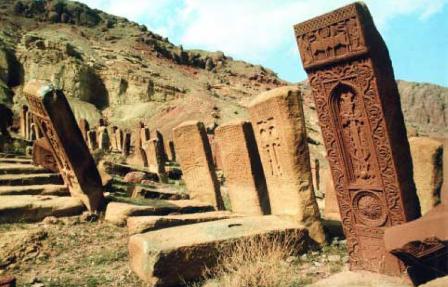
The Djulfa Virtual Memorial and Museum (www.djulfa.com), announced in January of 2008, claims to be the foremost online resource on the medieval cemetery in old Djulfa (Jugha in Armenian), which was reduced to dust in December of 2005 by a contingent of Azerbaijan’s army. The destruction, videotaped by a film crew at the Iranian-Azerbaijani border, and condemned by the European Parliament, has been denied as “slanderous information” by officials in Azerbaijan.
The newly launched project includes film and reference material on the history and destruction of the Djulfa cemetery. The Photo section features a number of previously unpublished images of the cemetery taken by French-Lithuanian art critique Jurgis Baltrusaitis, who visited the site in 1928. A publication co-authored by Baltrusaitis has also been digitalized and posted on the website.
The Djulfa Virtual Memorial and Museum is maintained by volunteer staff and an advisory board. Learn about the annihilated sacred stones at www.djulfa.com.