The United States House Foreign Affairs Committee has passed (43 yes; 1 no) an amendment calling on Turkey to return Christian properties to their rightful owners. That would be 2,200 Armenian sites (a number concluded from statistical research instructed by Turkey’s Interior Ministry to Archbishop Maghakia Ormanian from the Armenian Patriarchate of Constantinople during 1912-1913), as well as hundreds of Greek and Assyrians properties.
Kudos to the Armenian National Committee of America for initiating the “return of churches” campaign. While the U.S. government is very careful not to use the term “genocide,” genocide recognition can be achieved indirectly, such as addressing the cultural loss caused by the genocide. Turkey understands the last point very well; that probably explains the official Turkish anxiety over the issue.
Nonetheless, Turkey must preserve its diverse heritage – with or without acknowledging the Armenian genocide. In 1969 Turkey signed the International Treaty for the Preservation of Cultural Monuments. Moreover, Turkey has also signed the United Nations Declaration on the Rights of Indigenous Peoples which underscores indigenous peoples’ “right to maintain, protect, and have access in privacy to their religious and cultural sites.”
via Asbarez, a video conversation with US vice president Joe Biden discusses the process of Armenian genocide recognition. Biden claims that he was asked by Armenia’s president not to press on the issue of genocide due to talks with Turkey regarding border reopening. He also says Turks must admit the past.
UPDATE: The US Embassy in Armenia has issued a press release effectively denying Biden’s claims that he was asked by Armenia’s president to delay Armenian genocide recognition.
Recep Tayyip Erdogan, the Turkish prime minister, has been in London, with a photo-op next to Gordon Brown, his British opposite number, on the steps of Downing Street. The ceremony, the courtesy, goes with the job. In return, Erdogan did something extraordinary. He threatened to expel 100,000 Armenians from Turkey. “They are not my citizens. I am not obliged to keep them in my country.” My citizens? My country? Mass expulsion? This is the mind-set and the language of a dictator.
[…]
In the context, the threat of expelling 100,000 people is less a hang-over from the past than evidence of the kind of world already taking shape.
Over two millennia ago, this Greek leader’s kingdom stretched from Europe to Asia. He was not Alexander the Great and his empire was much smaller. Yet he revived Greek democracy, freed slaves, inspired Mozart’s first opera but also mastered a massacre of Roman settlements in what is today western Turkey.
Controversial alike every other classical celebrity, Mirthradates the Great’s once vibrant story has nowadays deliberately disappeared largely due to, according to History Today, a genocide that took place two thousand years after the Greek king’s and his even more successful Armenian son-in-law Tigranes the Great’s times.
In the words of Adrienne Mayor:
“[…]
Why was the once renowned Mithradates the Great so forgotten? Should we blame Shakespeare for neglecting to immortalise his struggle against Rome? Or fault Marxists for favouring Spartacus, the gladiator-rebel of Thrace instead of the King of Pontus?
It is not difficult to guess why memories of both Mithradates and Tigranes have been suppressed in Turkey, which still officially denies the 1915 Ottoman genocide of Armenians in Tigranes’ old kingdom and the deportation of Greeks from Pontus, Mithradates’ philhellenic realm.
[…]”
The genocide of indigenous Anatolians (Armenians, Pontus Greeks, and Syriacs) during WWI is a timeless event. Its official Turkish denial in the 21st century is not a mere distortion of a hundred-year event, but unproductive cover-up of thousands of years of history that took place earlier.
After repeated silence from municipal officials regarding a name change, a civil society group in Istanbul, Turkey has itself replaced the sign of a local street from that of a mythical toponym – used by a terrorist group – to the name of an Armenian journalist murdered three years ago this month by a ultra-nationalist youth.
The teenager who shot Hrant Dink – the editor of Agos newspaper and a promoter of reconciliation between Turks and Armenians – was allegedly recruited by Ergenekon, an elite military group which has failed its goal of toppling Turkey’s Islamic but moderate administration. Ergenekon, which is named after a mythical place and is revered by Turkish ultra-nationalists, supposedly had planned to kill other Armenians as well (prominent representatives of the handful of indigenous Christians who once numbered 20% of what is today’s Turkey).
Originally reported in Turkish by Bianet, the news is quite interesting: in a nationalist country like Turkey (even in relatively liberal Istanbul), such action can be dangerous (no official or nationalist reactions have been reported so far). But it is also inspiring, and giving hope that maybe, just maybe, progressive Turks – and hopefully Turkey as a society – will one day rename streets honoring the perpetrators of the Armenian genocide as well.
In Istanbul alone, there are four avenues celebrating the main architect of the genocide – Talaat.
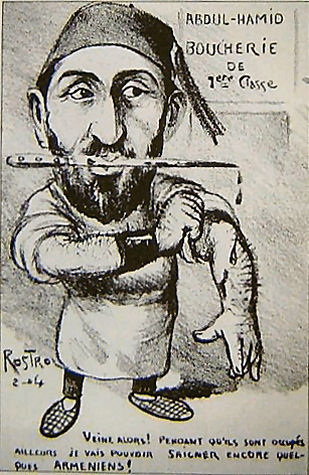
The late 19th century Ottoman Sultan Abdul Hamid II banned the use of the scientific formula for water. He thought that H2O might be interpreted as he (Hamid the second) being equal to nothing (zero). The reverse, unfortunately, was the case: even during his rule Hamid became a world-famous figure nicknamed the “bloody sultan” – for massacring almost quarter a million Christian Armenians in the late 1890s in lieu of introducing sought reform. A decade after the Hamidian massacres, the next Ottoman regime that replaced the sultan brought about the end of what is now eastern Turkey’s indigenous Armenian population.
Over a century after the Hamidian massacres and half a decade short of the centennial of the genocide that followed, a grandson of the “bloody sultan” says he is “on the side side of the truth.” One reason why Beyzade Bülent Osman admits, even as indirectly so, his forefather’s massacres and the genocide that followed is because his family “owed their lives” to an Armenian family in France that helped Mr. Osman’s family when they escaped from the Ottoman Empire.
The world knows Sultan Abdülhamit II as a key name related to the Armenian issue and the events of 1915, recognized as genocide by many countries, a claim Turkey rejects. “I am on the side of truth,” Osman said on the issue. “The French and the Germans had also slaughtered each other, came into conflict but still managed to establish dialogue. We have to leave history behind us and look ahead.”
Osman also said his family “owed their lives” to French-Armenians after their exile from Turkey. “We were penniless,” he told the Daily News. “Our Armenian friends helped us. There was an Armenian lady who welcomed us to her chateau and we lived there for a long time. I cannot deny the good deeds Armenians have done for my family.”
A higher court in Turkey has returned 44 of 100 acres to an Armenian family after decades of legal battle, an unprecedented act in a country where the indigenous Armenian population was wiped out during WWI, their ancient civilization destroyed, and their private property confiscated.
But while most of the land the Christian Armenians once owned is in rural (and poor) eastern Turkey, the 44 acres the France-based Agopyan family will recover is in Istanbul’s affluent Tarabya neighborhood, located on the European shores of the Bosphorus. Estimated at billions in value, the land houses luxurious villas, historic places, night clubs and restaurants.
Sources (in Turkish):
http://haber.gazetevatan.com/haberdetay.asp?Newsid=265882&Categoryid=1
http://www.emlakkulisi.com/15237_agopian_ailesi_nin_1955_te_actigi_arazi_davasi_suruyor
Via Tamara Azarian
A contribution by a security analyst who has requested anonymity
Concerned about the “historical commission” in the Armenian-Turkish protocols that may investigate the veracity of the Armenian Genocide? You should be if you are an idealist who believes that patently obvious facts should not have to be proven again and again. For many, this endeavor is as impossible – if not as pointless – as it is to enlighten someone who intransigently insists that the sun orbits around the earth, despite that fact that science proved the opposite centuries ago. That being said, I never want to give up on someone who genuinely seeks the truth.
The Armenian “case,” also known as the truth, is quite simply unassailable no matter what tactic genocide deniers may use. This article will set out to eviscerate just one possible Turkish tactic by hypothesizing that everything the Turkish government says about “Armenian rebels” is true; that these militias didn’t simply exist as means of last ditch self-defense, but were instead instruments of insurrection and secession. (Which, nevertheless, would be fully justified after hundreds of years of oppression from a government that Armenians never contested to be part of)
The most damning evidence that shows that Turkey carried out genocide against the Armenians is a comparative analysis with the Arab Revolt. Just as a reminder, during WWI many Arabs openly sided with the British. They were resentful of heavy-handed Turkish rule, and wanted to be independent. As with most nationalist movements, this revolt initially started on a smaller scale, and ultimately mushroomed into full-scale warfare between Ottoman Turkish forces and Arabs.
So where is the “damning” evidence I am talking about? The fact of the matter is that the Ottoman Empire had the military capability to conduct the same measures against the Arabs, i.e. genocide, as they did against the Armenians. The Ottoman Government could have simply cited the same reason they used to justify the Armenian Genocide, “they were siding with the enemy (which was true in the case of the Arabs), and that the homeland must be preserved at all costs.”
As indicated by the outcome, the Arab revolt was every bit as dangerous to the Ottoman Empire as was the so-called “Armenian Revolt.” Yet, in the end the Ottoman Empire did not target Arab civilians as it did Armenian civilians. While Arab lands were still under Ottoman control, Arab residents of Damascus, Aleppo, etc were not exiled into the wasteland without food, water or shelter. Instead the Empire, for the most part, restricted its violence to actual Arab militias. Certainly, skeptical readers might say, the Arab Revolt originated in the uncontrollable and wild Arab Peninsula, not domesticated Damascus. But, this same skepticism can and should be applied to the Armenian case as well. Even the most fanatical Turkish apologist will not claim that the alleged “Armenian Revolt” existed in Bursa, Konya, etc., yet the Armenians of these Anatolian cities were nevertheless marched into the desert and slaughtered en masse. So what possible conclusion can be drawn from the comparison? The Ottoman government’s policy regarding the Armenians was not just some necessary wartime contingency.
Except wait…
Some denialist historians might say that the Ottoman Empire was ultimately willing to lose the Arabian lands. Arabia was not vital to the empire’s existence, and its loss did not represent and existential threat. Turks did not live there in significant numbers, and they were more overseers than anything else. Conversely, these historians will claim the same is not true in the Armenian case, and that Anatolia is the heartland of the ethnic Turks. Had Armenians carved out an independent country there, or so the denialist argument goes, the existence of the Turkish people would be threatened. But this argument is not valid either. Eastern Anatolia at the time was an ethnic mosaic, and rarely did Turks constitute an outright majority. In fact, in many places such as Bitlis, Armenians were the largest ethnic group followed by the Kurds. Here and in other places in the region, Turks were actually only a small minority. Therefore, the same demographic argument that says Arabia wasn’t important to Turkey also applies to Eastern Anatolia.
To this, a denialist historian might answer, demographic reality is not as important as the perception of Turks. But again, Eastern Anatolia does not feature prominently in the hearts or lore of Turks (even till this day), with one minor exception being Alp Arslan and his battle at Manzikert in the 11th century. Instead, Eastern Anatolia has always been more like a colony, such as the Balkans, than an integral part Turkish identity. The real homeland, the real gem, to Turks at the time of WWI is further west where the Ottoman Empire actually originated, places like Eskisehir.Therefore, fear of losing Eastern-Anatolia as opposed to Arabian lands is not a justification for Ottoman policies vis-à-vis the Armenians, especially when considering that the Levant is just as close to the heart of Turkish identity, western-Anatolia, as is Eastern-Anatolia.
In conclusion, the Ottoman Empire’s brutal treatment of the Armenians, even if they were in full revolt (which they weren’t), was reserved for Armenians alone, despite other rebellions in the Empire. It is now incumbent on denialist historians to explain the huge differences in policy with respect to an identical security threat. All this being said, severe annoyance with this “commission” is justified, because denialists are most likely not really looking to debate the veracity of the Armenian Genocide, but instead are mainly interested in the mere illusion of controversy.
P.S. There is no rule that says that genocide cannot occur simultaneously with war and rebellion, as Armenian Genocide deniers would mistakenly have you believe. If anything, a genocide that occurs without the backdrop of rebellion, even rebellion committed by the victim group, represents an anomaly. I am going to give just three examples of genocides coinciding with rebellion, though many more cases exist. The Rwandan Genocide of the Tutsi people coincided with the Tutsi RPF rebellion in the same country; the Herero Genocide coincided with a rebellion in German South-West Africa by the Herero; lastly the Genocide in Darfur which coincided with the JEM rebellion in Sudan. If you were to apply the same (rebellion = no genocide) argument that denialists use against the Armenian Genocide, you would have to deny every other genocide in history.
“Who controls the past controls the future;” party slogan states in George Orwell’s dystopian novel 1984, “Who controls the present controls the past.”
While hopes are high that – despite a hostile history – Armenia and Turkey will establish diplomatic relations and that the Nagorno-Karabakh conflict between Armenia and Azerbaijan may finally be solved, the problem of how to deal with the official Turkish/Azerbaijani factory of history is not being addressed.
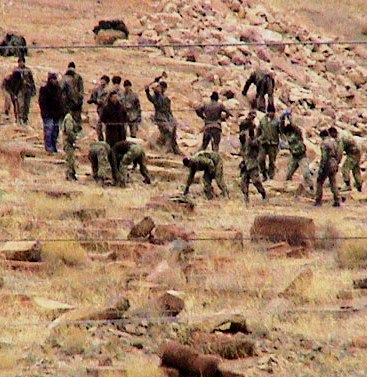
Djulfa, Nakhichevan: the worst documented case of history fabrication; Azerbaijani soldiers destroying the largest Armenian medieval cemetery in the world (December 2005) – the site is now a military rifle range
It’s not merely Turkey’s and Azerbaijan’s denial of the Armenian Genocide that makes the reconciliation quite difficult, to say the least, but also the official Turkish thesis, with its roots in the Young Turkish movement (that carried out the Armenian Genocide) and formalized by Ataturk, that Turks/Azeris are indigenous to their current homelands and that Armenians, in the best case, are unwelcome immigrants.
While the Turkish fabrication of history can be dismissed as an issue of “internal consumption” – meaning a convenient myth to boost Turkish/Azeri pride in their respective countries (with the dangerous slogan “Happy is the man who can say I am Turk”) – the implications of flip-flopping history are right there in the middle of the current developments in the region. Here is a most recent case.
Turkey’s ceremonial president Abdullah Gul is currently visiting Nakhichevan (or Nakhchivan as Azerbaijan prefers), the region of Azerbaijan which it got from the communist regime in Moscow as another gift at the expense of giving out Armenian lands. Moreover, a treaty that Soviet Armenia was forced to sign from Moscow made Turkey the “guarantor” of Nakhichevan in the 1920s.
Gul is visiting Nakhichevan with other heads of “Turkic-speaking countries” (most of them in Central Asia) to talk about common issues. Sounds like a normal political event, and nothing to protest about, especially since Armenia has no official claims toward Nakhichevan. But read the rest.
As there are no Armenians left in Nakhichevan (thanks to a Soviet Azerbaijani policy of nonviolent ethnic cleansing which attracted little attention at the time) and not a trace of the rich Armenian heritage (the most precious of which, the Djulfa cemetery, was reduced to dust by Azeri soldiers in December 2005 – see the videotape), Armenia has no claims to Nakhichevan and perhaps rightly so. Yet, apparently, the history factory in Nakhichevan is still cooking.
While Armenia restraints itself from claiming its indigenous lands, and particularly Nakhichevan, taken away from it without its consent, Turkey and Azerbaijan must discontinue their unhealthy fabrications of history. Instead…
Putting the “native” side aside for a moment, the distortion of not just basic history but of linguistics is sickening. Save for the disputed proposal that Nakhichevan comes from the Persian phrase Naqsh-e-Jahan (image of the world), every other explanation of the name of the region has to do with Armenians (see Wikipedia for the several versions), let alone that the word itself has two Armenian parts to it: Nakh (before or first) and ichevan (landing, sanctuary) – referring to Noah’s coming out of the Ark from (another holy Armenian symbol) Mount Ararat – next to Nakhichevan now on Turkish territory.
Ironically, and as almost always in history fabrication, the Azeri/Turkish distortion of “Nakhichevan” is inconsistent. According to an official Azerbaijani news website, there are discussions in Nakhichevan that admit that the word has to do something with Noah (of course after saying that it had to do with a mythical Turkish tribe that lived there thousands of years ago): “The Turkic tribes of nakhch were once considered as having given the name to it. Other sources connect Nakhichevan with the prophet Noah himself, as his name sounds as nukh in Turkic.” Moreover, as an official Nakhichevani publication reads, “There is no other territory on the earth so rich with place-names connected with Noah as Nakhichevan. According to popular belief, Noah is buried in southern part of Nakhichevan, and his sister is buried in the northwest of the city.” Hold on. Did you notice that the language uses (at least its official English translation) the Armenian taboo name of the region: Nakhichevan (as opposed to Turkified Nakchivan)? Maybe there is hope, but not really. Azerbaijan still denies that it didn’t destroy the Djulfa cemetery because, well, it didn’t exist in the first place.
A skeptic would ask what the fuss is about. The answer is that Nakhichevan’s distortion is not the first. The sacred Armenian places of Ani, Van, and Akhtamar in Turkey all have official Turkish explanations to their meanings, while those places existed for hundreds – if not thousands – of more years before Turks colonized the homeland of the Armenians.
More importantly, the changing of toponyms is not done to meet the social demands of Turks/Azeris and in order to make it easier for the locals to pronounce geographic names. Distortion is done to rewrite history in order to control the future. But it’s not the right thing to do. And both Turkey and Azerbaijan embarrass themselves when it comes to legal discussions.
Immediately prior to voting for the Declaration on the Rights of Indigenous Peoples in September 2007, for example, the Turkish delegation at the United Nations made it clear that its “yes” vote was cast with the understanding that there were no indigenous peoples on Turkey’s territory. If there were indigenous peoples on the territory, the Turkish representative stated, then the declaration didn’t challenge states’ territorial integrity. Azerbaijan, on the other hand, abstained from voting.
The reservation on the UN document came from both countries who claim that there are the indigenous heirs of the lands they occupy and that their main enemy, Armenians (and also Kurds) are not only indigenous but are recent immigrants.
One version of Azerbaijan’s ridiculous inidigenousness claim is written on the website of one Azerbaijani Embassy: “The ancient states of Azerbaijan, which maintained political, economic and cultural ties with Sumer and Akkad and formed part of the wider civilization of Mesopotamia, were governed by dynasties of Turkic descent. The Turkophone peoples that have inhabited the area of Azerbaijan since ancient times were fire-worshippers and adherents of one of the world’s oldest religions – Zoroastrianism.”
Armenians (and to a large extent the Kurds, Assyrians and Pontiac Greeks) have their share of fault in the debate. Constantly repeating their indigenousness in what is now Turkey and Azerbaijan, Armenians have helped create the defensive Turkish/Azeri attitude that they, and not Armenians or others, are the indigenous peoples of the land. But when it comes to fabricating history of their own, there is little blame for Armenia.
As Armenia struggles to defend the victory it won over the Karabakh conflict, most Armenians use the Turko-Persian name for Nagorno-Karabakh (Karabakh meaning black garden, Kara – black in Turkish and bagh – garden in Farsi). While some Armenian nationalists prefer using the indigenous name of the region, Artsakh, many others indirectly admit that diverse history of Nagorno-Karabakh by keeping its Turkified name.
While Turkey ad Azerbaijan must come to terms with history, Armenia must accept that Turks and Azeris are there to stay. All the nations in the region have equal rights to existence, but not so at the unhealthy price of fabricating history.
A regional court in Iran has banned a Jewish couple from obtaining German citizenship since Tehran doesn’t recognize the Holocaust. Pretty outrageous?
Actually, as crazy as Iran is such a court decision is unlikely to take place there. But a similar, even more absurd ruling has been made in the United States. According to the Ninth Circuit Court’s circus decision, since the US Administration doesn’t formally recognize the Armenian genocide California cannot have a law allowing Armenian-Americans sue insurance companies to claim their killed ancestors’ policies.
But, how is fine analysis different from Catholic Church’s decision to excommunicate Galileo or Josef Stalin’s decision to promote the fraudulent biological theories of Trofim Lysenko? Both the Church and Stalin also made their factual determinations based on policy.
In Movsesian, the court elevates policy over fact. Instead of undertaking an investigation into whether there was an Armenian genocide, the court resolved the factual question by a policy analysis, which is always a superior way to determine facts.
I am not exactly an expert on the Armenian genocide, but I have read the dispatches from US ambassador Henry Morgenthau. But, I guess his reports cannot be factually correct because they too are contrary to President Obama’s foreign policy and therefore are preempted.
Next week, the 9th Circuit Court of Appeal will issue its long awaited decision on whether our foreign policy requires college professors to teach that the moon is made out of cheese and that Saddam Hussein has weapons of mass destruction.