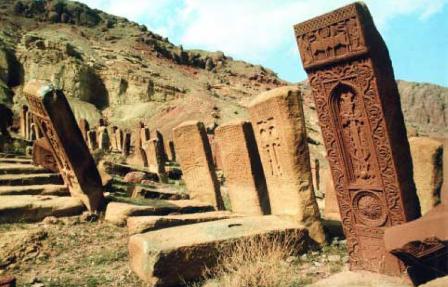
A high-resolution satellite image of a medieval Armenian cemetery in Azerbaijan taken in September 2003 shows hundreds of khachkars, intricate 15th and 16th century burial monuments. In a satellite image from May 2009, however, the khachkars are missing, suggesting that they were either destroyed or removed.
…
“Geospatial images allow us to shed light on regions that are not accessible, providing a visualization tool for events or circumstances that are important to bring to the public’s attention but which, without some visual evidence, are less likely to attract attention and interest,” said Jessica Wyndham, senior project director of the AAAS Science and Human Rights Program.
In September of 2003 (upper data), the central area of the Djulfa graveyard appears to have sustained significant damage, but the areas to the northeast and southwest remain largely intact. By May of 2009 (lower data), however, the entire area has been graded flat, apparently by earthmoving equipment.
A close-up of the southwestern portion of the cemetery clearly shows the extent to which the area has been scoured. Upper data from 2003; lower data from 2009.
The northwestern area of the Djulfa cemetery in Azerbaijan has also been completely demolished. Upper data from 2003; lower data from 2009.
The AAAS team has also put together a video where Susan Wolfinbarger, senior program associate for the Geospatial Technologies and Human Rights Project, a part of the AAAS Science and Human Rights Program, explains their methodology and findings.
While Djulfa’s destruction was until now well-documented, the AAAS study conclusively, scientifically, and objectively confirms what Azerbaijan can no longer deny without ridiculing itself and what UNESCO – the organization charged with protecting our global heritage – can no longer keep silence on without discrediting its mission.
What UNESCO must do is to tell Azerbaijan that the former won’t add any new monuments from the latter to the World Heritage List until Azerbaijan’s authorities acknowledge the destruction at Djulfa and prosecute the perpetrators of this crime against world culture. That’s what the petition at http://www.thepetitionsite.com/takeaction/235/907/968/ demands and I hope that you will take one minute to add your signature to it.
This is complete bullshit. If there is no Armenian in Julfa, why should there be a cemetery? Bye-bye, cemetery! You, idiots, should have taken your fucking khachkars with you when you left Julfa. Your fault. Keep crying, you Armenian nomads from Phrygie [sic].
If you vote in an international music competition for Armenia, apparently you are threatening neighboring Azerbaijan’s national security. And no – this is not a Borat joke.
Radio Liberty reports that “Rovshan Nasirli, a young Eurovision fan living in the Azerbaijani capital Baku, says he was summoned this week to the country’s National Security Ministry — to explain why he had voted for Armenia during this year’s competition in May.”
Only 43 people in Azerbaijan – a country of over 8 million – voted for Armenia during Eurovision 2009. It was said that Azerbaijan had turned off the broadcast when the information on how to vote for Armenia came up.
While I have received a number of personal letters from individual Turks apologizing for the Genocide, this one is addressed to all Armenians: “My conscience does not accept the insensitivity showed to and the denial of the Great Catastrophe that the Ottoman Armenians were subjected to in 1915. I reject this injustice and for my share, I empathize with the feelings and pain of my Armenian brothers and sisters. I apologize to them.”
The thousands of Turkish signatories of the apology statement are not saying sorry for the genocide itself (which they call “the Great Catastrophe,” translating from the Armenian Metz Yeghern). The apology is for the convenient “ignorance” and “denial” about the WWI extermination of Ottoman Empire’s indigenous Armenians for about nine decades. The message, as I see it, is not recognizing a historical fact but recognizing humanity. To recognize genocide means to recognize a victim group’s humanity. The reverse can, apparently, be true as well.
What is also true is that there are thousands of Turks who are willing to risk their lives and comfort in order to break an ancient silence. As one Turkish friend told me, “[i]t’s a bit like putting your name on a ‘wanted’ list.” The “wanted list” is pretty big: over 22,000 signatures on the main website, http://www.ozurdiliyoruz.com/, by December 24, 2008, and over 3,400 on Facebook (as of Dec 20) with their real names and photographs (the Facebook event list seems to have since become a private one).
On the other hand, all that Armenians have received for losing a homeland and memory through genocide is a 90-year-late “apology” by a group of people some of whose signatories don’t hide its strategy. One initiator, for instance, has been quoted as suggesting in one Turkish-language newspaper that the apology is a service to the Republic of Turkey in the sense that it will kill genocide recognition by other countries. Furthermore, earlier this year, in my indigenous politics class, the professor and many students were not satisfied with Australia’s and Canada’s official apology to their indigenous peoples for genocidal policies. So in general, an “apology” is not well received by victim groups.
Nevertheless, Turkish media are openly calling Canan Arıtman, the female member of a social-democratic party who suggested Gul is a traitor because of his alleged Armenian origin, a “fascist” and a “racist.” Suggesting that the politician be expelled from her party, one Turkish columnist writing for Sabah says, “Arıtman is racist. What place can racism and questioning ethnic origins have in social democracy, an ideology that has freedom, equality and brotherhood as its fundamental tenets?”
Writing even harsher, a liberal Turkish columnist asks what if all Turks have Armenian origin:
“Arıtman and those like her are the strongest reason we have to apologize to the Armenian community. If these people can readily put into circulation statements that are racist, low and self-aggrandizing, the entire community is responsible for that. We all have a share in this crime. I have questions to ask people who approach this issue reluctantly and who think that it is unnecessary as an agenda item. Have you ever thought about this? Maybe we are all really Armenians. We may all have people in our lineage who were forced to act like Muslim Turks.”
A Zaman columnist says Turks “should thank the racist CHP deputy” for reminding the history of her political party. Apparently that political party is the hereditary of the chauvinist “Union and Progress” that committed the Genocide in 1915.
Furthermore, some of Arıtman’s colleagues in the parliament have compared her to Hitler: “”It was a similar stance that led German dictator Adolf Hitler to burn thousands of people of Jewish origin. Arıtman sees Armenians as enemies.”
When was the last time when any media in Turkey was outraged against insulting Armenians? Indeed this is unprecedented and demonstrates the power of the apology – no matte how vague and not-enough it may be. This maybe the reason why there is so much ultranationalist outrage in Turkey against the apology (even if some self-perceived progressives silently suggest the apology serves Turkey’s national interests). The website of the apology, for instance, was “suspended” according to a message which appeared on it around 1:30 AM standard US eastern time on December 23, 2008. Days ago it was also hacked. Furthermore, a group of nationalists have opened their own website called “I don’t apologize.” Almost 50,000 nationalists have signed it as of December 24. Another counter campaign claims twice as many supporters, although neither websites have received much – if any coverage – in Turkish or other media.
Hated by Turkish ultranationalists, the apology initiative has inspired similar (though low-profile) campaigns in the region. I have received a text that is being circulated among Cypriot Turks and Greeks asking both communities to apologize to each other:
“Initiative for Apologizing for the atrocities committed by ones’ own community
1. This is an initiative to collect signatures on a document apologizing for the atrocities committed by ones’ own community against the other. Following the initiative of 200 Turkish intellectuals, who found the courage to apologize for the Armenian genocide, we believe it is time for Cypriots to assume responsibility for the crimes allegedly committed in their name and to express regret and condemnation.
2. The initiative also aims at putting an end to the decades- long practice of concealing the truth about the events, of denying that they ever took place or attempt to justify them. This amounts to a crime of massacre denial which can no longer be tolerated. At the same time each one of us must assume responsibility for the actions we can take as parents, teachers, activists, journalists, politicians to put an end to the decades-long conspiracy of silence about our regrettable past.
3. We call on all interested persons and organizations to engage in a process of consultation on how best to promote this initiative and to formulate the text to be signed.”
Full of more potential for good than for bad, the Turkish apology is one that surprises many. In fact, it might not have been possible without one person. According to the Irish Times:
“[…]
Others attribute the initiative to the shock that followed the murder of the Armenian-Turkish editor Hrant Dink. A leading advocate of a more humane debate on the Armenian issue, Dink was gunned down by a nationalist teenager in January 2007.
“When he died, it was as if a veil had been torn from the eyes of the democratic-minded citizens of this country,” says Nil Mutluer, a feminist activist who signed the letter. “People realised there was no time to be lost.”
The road ahead looks hard. The chief organisers of the 1915 massacres continue to be commemorated in street names across the country….”
The road is a hard one, but not unprecedented. Around the globe, there is a global recognition of indigenous rights which have often been repressed through genocidal policies. One such injustice was recently corrected by the country of Nicaragua when it gave title of traditional land to a native nation. A simple apology seems to please many Armenians, though, even it comes froma group of liberal Turks who are ashamed of a 90-year-old campaign to silence and rewrite history.
When I gave my father a print-out of the apology in western Armenian, his initial reaction was: “They took all of our land and memory and all they give us is an apology by a group of small people who don’t even use the word genocide?” To my surprise, he then added, “I accept their apology.”
And earlier this April, when a group of Turkish lobbyists and community organizers denied the Armenian genocide during a commemorative lecture at University of Denver, an Armenian friend of mine (who openly calls himself a nationalist), said to the audience that if a Turk told him “sorry” for the Genocide he would give that Turk a “big, Armenian hug.”
My friend owes 20,000 Turks big, Armenian hugs. Let’s hope the number grows so big that he will never be able to give so many hugs in 90 years.
Three years after a cemetery dating back to the 9th Century was deliberately destroyed in the Azerbaijani exclave of Nakhichevan, bloggers recall an ancient culture annihilated and condemn the world for closing its eyes to what many consider to be an official attempt to rewrite history.
Today is the commemoration of the 3rd anniversary of Djulfa’s destruction. …This [is] not only a crime against Armenian culture, but against our collective cultural heritage as humankind. Don’t let it go unnoticed.
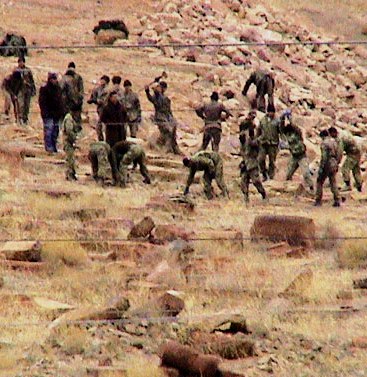
Between 10-16 December 2005 over a hundred uniformed men were videotaped destroying the Djulfa cemetery using sledgehammers, cranes, and trucks. The video was taken from across the border in Iran.
Азербайджанские власти на протяжении всего советского периода старались уничтожить этот некрополь, поскольку для них он был всего лишь свидетельством о том, что именно армяне были хозяевами этой территории на протяжении веков, вопреки тому, что говорилось в азербайджанских советских мифах о собственной “древности”… Это кладбище, вполне достойное названия чуда, было даже не внесено в реестр архитектурных памятников Азербайджана… После распада СССР, во время карабахского конфликта, продолжалось разорение кладбища, и, наконец, оно было окончательно уничтожено….
The Azeri authorities throughout all Soviet period tried to destroy this necropolis as for them it was only a testament that Armenians were owners of this territory throughout centuries in spite of Azerbaijan’s Soviet myths about own “antiquity”… This cemetery, quite worthy to be called a wonder, was not even placed on the register of architectural monuments of Azerbaijan… After USSR’s collapse, during the Karabakh conflict, the cemetery’s demolition continued, and, at last, definitively destroyed….
آنان از سنگ قبر ارامنه هم نگذشته اند و با تخریب دوازده هزار قبر با سنگ قبر هایی منحصر به فرد که متعلق به چند قرن پیش بوده و جزئی از میراث فرهنگی ارامنه به حساب می آمد، هیچ اثری از ارمنی نشین بودن آنجا، بجا نگذاشته اند.
[After acquiring Nakhichevan, Azeris] did not even tolerate Armenian gravestones. They destroyed twelve thousand Armenian graves. These unique gravestones with several centuries’ history were part of Armenian cultural heritage. However, through destruction of these gravestones, [Azeris] destroyed all signs indicating the existence of Armenians in that land. [translated by Loosineh M.]
iArarat, remembers Djulfa by discussing Robert Bevan’s The Destruction of Memory: Architecture at War, a book that was “part of a class I teach at a Texas university on nationalism and ethno-political conflicts.”
[…]
While reading Bevan’s book I was inevitably reminded of the destruction of the medieval Armenian cemetery in Jugha, presently in Azerbaijan. Azeri soldiers at the command of their superiors without as much as blinking an eye would embark at destroying and erasing the last vestige of the Armenian civilization in that territory as if the Armenians had never as much as existed there, as if Armenians had never as much as created anything, something to celebrate their faith and commemorate their dead…
Adding insult to injury, earlier this month Baku, Azerbaijan hosted a little-noticed two-day conference of Council of Europe culture ministers to discuss “Intercultural dialogue as the basis for peace and sustainable development in Europe and its neighboring regions.” In his opening remarks to the attendees Azeri president Ilham Aliyev, astonishingly claimed:
“Azerbaijan has rich history and the cultural monuments here are duly preserved, and a lot is being done in this direction…”
Meanwhile, nrbakert_tashuk [Ru] asks whether one should laugh or cry at attempts to represent other indigenous Armenian monuments as Turkish or Azerbaijani. However, Kornelij [RU] says Armenia is also to blame for not participating in a conference held early this month in the Azerbaijan capital, Baku.
[T]he Armenian Ministry of Culture failed to deliver a message by boycotting the conference. They either should have properly boycotted the conference by making an appropriate statement explaining the reasons for non-participation, or they should have participated there to raise the all important issues of destruction of Armenian cultural heritage in Azerbaijan, as well as protecting and restoring the multinational cultural heritage in all three South Caucasus countries [Armenia, Georgia, and Azerbaijan].
old-dilettante [RU], says that Djulfa’s destruction was the last stage of Azerbaijan’s attempt to eradicate Nakhichevan’s Armenian heritage. Commenting on a post about churches in Georgia, she writes:
Теперь там не найдется ни одной армянской церкви, несмотря на фотографии и книги, изданные всего ничего – лет 20 тому назад. Все церкви уничтожены. Все могилы. Все хачкары.
И кто через 20 лет скажет, что там вообще жили армяне? … А ведь мой дед был “местным жителем”.
…Now, not a single Armenian church will be found [in Nakhichevan] despite of photographs, some as recent as 20-years-old. All churches are annihilated. All cemeteries. All khatchkars.
And who will say in 20 years that Armenians ever lived there? … It wasn’t that long ago that my own grandfather was a “local” there.
Also recalling family history, Washington-based Armenian journalist Emil Sanamyan, a native of Azerbaijan’s capital Baku, commemorates the destruction of Djulfa.
In Baku Armenian cemeteries with less historical but more immediate sentimental value to many (including my family whose three generations made their home in Baku for nearly a century) were paved over for roads or new construction. That does not justify the disrespect they were afforded but makes some remote sense.
In the case of Jugha khachkars stood in the middle of nowhere and were simply crushed, dismembered, thrown into the river. They were targeted and wiped out as the last remaining Armenian outpost.
Sarcastically, the journalist-blogger considers how other Armenian monuments on Azerbaijani territory could be protected.
Now I am thinking, perhaps Armenians should disassemble the remaining Azeri mosques and gravestones on their territory and exchange them for the khachkars and other Armenian heritage items of value?
Certainly some of the Azeri items have cultural value for Armenia and I would rather not see them go. But what other options are there?
Reacting to a comment on his above-mentioned post, Ivan Kondratiev [RU] also says that if Azerbaijanis wanted to cleanse their territory of Armenian heritage, they could have at least given the monuments to Armenia even if such a transfer would amount to acknowledging Djulfa’s Armenian history.
Is the world willing to confront deliberate destruction of historic monuments? In her long post on Djulfa’s destruction, The Stilettosees hope in an Obama administration.
[T]here is reason to be optimistic that [Barack Obama’s] foreign policy team will… have a very different response to the ongoing stonewalling by the Azeris than [current US Secretary of State] Rice’s utter disinterest [about Djulfa’s destruction], which is rooted in the Bush administration’s pro-Azerbaijani, pro-Turkey foreign policy.
In addition to secretary of state nominee Hillary Clinton […] prospective U.N. Ambassador Susan Rice has a particular interest in genocide and is an advocate of military action to stop mass killings, rather than ineffective “dialogue” as slaughters continue apace. And Harvard professor Samantha Power, author of “A Problem from Hell: America and the Age of Genocide” (2002), has been quietly advising Obama behind the scenes […].
Given that past is prologue, with these women’s combined emphasis on championing human rights and genocide prevention, it will not be easy for the Obama administration to ignore or overlook the genocide that preceeded – and encouraged – all others in the 20th and 21st centuries, or the ongoing “cultural genocides” in Azerbaijan and Turkey against the archeological remains of a once-thriving, centuries-old Armenian population that is no more.
More photographs of the cemetery, before and after its destruction, are available at www.djulfa.com.
Turkey is nowhere close to recognizing the 1915 genocide it committed against Armenians and Assyrians, but at least a museum in the historic Armenian town of Van, now claimed by local Kurds, has removed artifacts that previously showed “Armenian atrocities” against Turks:
In the words of a visitor to the newly-renovated Van museum:
Now that the museum is open, we can make our own assessment of the renovation it underwent between 2006 and 2008.
The ground floor remains very much the same, with wonderful Urartian artifacts that include pottery, metalwork, jewelry, and furniture. There isn’t a great deal, but what one can see is both fascinating and beautiful.
The “Armenian atrocities” section on the upper floor is removed. It is replaced with more Urartian artifacts, as well as ethnographic materials, such as kilims, period costumes, Ottoman swords, rifles, and revolvers, as well as household items and Korans.
Considering all the effort that has gone into the removal of the “Armenian atrocities” section of the museum, and all the thought that must have gone into the content of the newly designed upper floor, one is disappointed to see that Armenians have been made invisible in this new museum: there is nothing that refers to Armenia or Armenians anywhere. Although there is a map of the region showing a number of churches and monasteries, they are not identified as Armenian churches or monasteries, nor is there any explanation anywhere in the museum that mentions either Armenia or Armenians in a historical context.
Genocided, Islamized, assimilated, and few – Tokat’s handful of hidden Armenians in this northern city of Turkey still face institutionalized and societal discrimination. Local Turks don’t give them daughters to marry, and the local government doesn’t give them jobs to work. The only Armenian monument, a cemetery, is full of garbage and human waste left by its usual visitors – vandals looking for gold.
Amberin Zaman, Turkey’s reporter for The Economist, has published a column in the Turkish-language Taraf (July 10, 2008) detailing what she saw in a town once rich of Armenian life and culture. In her own words (translated by Amberin Zaman):
Recently I was in in Tokat, known as the breadbasket of Turkey and for its lush green vegetation. Tokat has been a city with a significant Armenian population, especially before 1915. […] Armenians living in the sancak of Tokat numbered 22, 733. There were seven Armenian churches and a monastery. Between 1910 and 1912, the magazine Iris was published first as a weekly, and later as a monthly newspaper. There were Armenians here, even if not that many, up until the 1960s. [According to the Dictionary of Toponymy of Armenia and Adjacent Territories, there were 400 Armenians in the 1930s and 40s – Blogian.] But today it is almost impossible to find traces of them. Their churches, houses, and schools have all been destroyed. Those who have remained are trying to continue their lives under the Muslim identity. But of course everyone knows they are Armenians.
The “secret” Armenians of Tokat, whose numbers are not known, are having problems. One man caught between his two identities who spoke to us on the condition that we not give his name said that the biggest problem was trying to find girls for their sons. “The Turks gladly take our daughters,” he said, “so our girls are very lucky.” But there is no one for our sons, because Muslims don’t give their daughters to Armenians.” (According to widespread interpretation in Islam, while it is fine to take on a non-Muslim girl, the same is not true of boys.) When we asked whether the boys could find Armenian girls to marry, the man shook his head. The reason is that Armenians, in a very modern practice, do not allow intermarriage to families of relatives going back seven generations. “Because our numbers are so small, we are all related in one way or another, so there are no eligible girls.” That being the case, the boys tend to migrate from Tokat, while the girls become assimilated.
Another problem that has cropped up in recent years is that Armenian residents can no longer get work from the municipality. While in the past the Armenians, who have been forced to work in the handcraft professions, had been able to get contract work from the municipal authorities, they complain that they have not been able to get work since the AKP came to power in Tokat. “They only give work to their own kind,” one said bitterly. Although we were unable to look into this further or confirm it with non-Armenians, there is one shame of the AKP municipality in Tokat that is clear for all to see.
The condition of the Armenian cemetery, the last remaining evidence of the existence of Armenians here, is a complete disaster. As soon as you go through the open, rusted door, you come across human waste, broken beer bottles, and all kinds of garbage. The condition of the graves, which we documented on film, is heart-wrenching. Most of them have been swallowed up by grass, while many of the gravestones that are visible are broken. Some of the headstones have been completely destroyed.
“People still come here to look for gold,” said Muharrem Erkan, a Tokat tour guide and one of the local directors of the Pir Sultan Abdal Association.
We didn’t get a chance to find out who is legally responsible for upkeep of the cemetery ? the Armenian Foundations? the municipality? — or what the laws and regulations say about this. But in fact that’s not what is important. Even non-practicing Muslims know that one of the fundamental principles of Islam is to show tolerance toward other religions. Tokat’s AKP Mayor, Adnan Cicek, needs to correct this human disgrace. He needs to get a lock for the gate, paint it, clean out the garbage, trim the grass, and for God’s sake plant a few trees and flowers there. We know that Mr. Cicek, who was deemed worthy of the title of Mayor of the Year, can succeed in getting this done, especially since the rest of the town is beautifully kept and perfectly orderly. It’s too late for those who have died, of course, but let us at least show respect to those of our Armenian citizens who remain here. NOW! PLEASE!
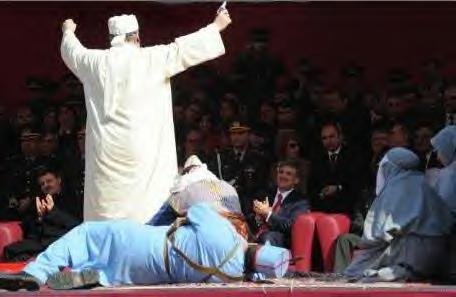
It turns out that Armenian killings continue all over Turkey in patriotic celebrations, and new photographs reveal that Turkey’s president Abdullah Gül participated in a February 12, 2008 ceremony where French soldiers of Armenian descent were killed by the Turkish army in a theatrical play.
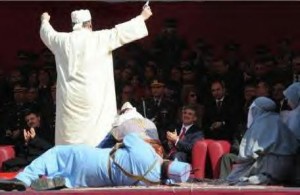
Image: Turkish president Abdullah Gül (right) cheers after a Muslim Turk, portrayed by one of the locals in Marash during a February 12, 2008 celebration, kills French-uniformed Armenians for forcing Muslim women to remove their veils. Gül seems to invest on hatred against Armenians in his goal to lift headscarf ban in Turkish schools.
Set to commemorate Turkish nationalists’ “liberation” of Marash, an Ottoman Armenian city under French occupation following the Genocide, the February 12 event recalls Turkish interpretation of the 1919 Marash events in Cilicia, the region of Armenia’s last kingdom currently part of Turkey. In the words of Turkish nationalist historian Ahmet Eyicil:
[…]
Among the French troops that came to Maraş were 40 Muslims from Alegeria and 4000 Armenians. The Armenians patrolling the city in French uniforms began to harass the women and suppress the people . They told to women “will you wander around under veil?” and forced them to “open your veils.” A retired Gendarme Çakmakcı Sait who was trying to prevent the Armenians harassing the women was shot and wounded. He later became a martyer. The Armenians, which came to the city in groups of 500 in French uniforms, asked the people where the whorehouse was. They later chanted the slogans “long live the Clichia Armenia. Down with the people against it.” Furthermore, they trampled on brade they bought from a store.The Armenians started to disturb the people on the streets from 31 October 1919, the second day of the French occupation. The indigenous Armenians gave alcoholic beverages to the newcomers. Some of the Armenian drunken soldiers molested the Muslim women coming out of historical Uzun Oluk baths. They force them to open their veils shouting “this is not a Turkish city any more . You can not walk around with veils. You must open your faces.” The women screamed for help. Upon all these a Turk named Imam who was selling milk in the neighboring shop came out shouting “you infidels! That is enough!” He pulled his gun and killed one and wounded two of them. This incident known as “Sütcü Imam or Uzunoluk incident” in the history spark off a great fight between the Armenians and the Turks . Two more Armenians were killed and fourteen people from both sides got wounded . This increased the Armenian oppression and the atrocities. The Armenians supported by the French started to shot each Muslim they met on the spot saying “this must be from Kuvay-I- milliye.” They started to kill the men and rape the women.
[…]
Interestingly, this celebration not only testifies to the omnipresent and seen-as-normal hatred against Armenians in Turkey, but also President Gül’s attempt to manipulate hatred against Armenians for his Islamic party’s cause to lift headscarf ban in universities.
The Marash celebration where Armenian men are killed after attacking Muslim civilians is only one in a series of theatrical plays in Turkey that have apparently been going on since the Armenian population was exterminated in what is today Turkey during and after WWI. Some Turkish newspapers criticized earlier this year the theatrical killing of Armenians in Van and in Erzurum, both former Armenian cities in modern Turkey. While this is the first year when some Turks are expressing outrage against the theatrical killings – perhaps in the light of Hrant Dink’s assassination – the celebrations, many say, have been going on for 90 years.
Justin Paul, an alleged law school student from Minnesota, has published an article in the Turkish Daily News suggesting Turks to find new, more civilized, methods of denying the Armenian Genocide. He compares some of the most anti-Armenian propaganda used by many Turks to anti-Semitism.
An example of this [“shotgun” method] is the site tallarmeniantale.com, which, while done by a lay person, has been championed by some Turkish lobbyists as a resource. The overall design of the site has become slightly less of an aesthetic blight over the years, but its content is jumbled, disorganized and often intellectually misleading.
This site launches ad-hominem attacks on Turkish intellectuals closer to the Armenian side, such as disparaging Fatma Muge Gokcek about her weight. It also portrays Armenians as arch Nazis on the basis of one particular collaborator, conveniently forgetting that many more Armenians died fighting Nazism.
The site basically strays far and away from any noble defense of the Ottoman Muslims who lost their lives in World War I and enters a realm of vicious anti-Armenian diatribe. Its intellectual companionship would be such conspiracy oriented rags like the Protocols of Elders of Zion, as you would leave this site thinking the Armenian Lobby pretty much controls the United States and is one hateful cabal.
The columnist, who seems to be mocking the Turkish denial but apparently he is not, suggests nationalist Turks to stop calling Turkish historian Taner Akcam – the first Turk to openly research and acknowledge the Genocide as such – Osama Bin Laden. He calls a Turkish film denying the Armenian Genocide “another failed attempt to make a noble defense” and complains that “there have been the outlandish signs at Turkish demonstrations which allege that Armenian [sic] killed 3 million Turks and Azeris.” He also doesn’t like when Turks use Pinocchio imagery to deny the Armenian Genocide. Too bad – that was my favorite part.
Having in mind that the article is published on April 1 Fools Day, one would think that Mr. Paul is mocking the Turkish denial and telling them to drop their principle arguments in denying the Armenian Genocide – Pinocchio, Nazism, Osama Bin Laden and 3 million dead Turks.
What Mr. Paul doesn’t realize is that genocide denial is a hate crime and cannot be nuanced, rationalized and toned down. If those nationalists Turks who were denying the Armenian Genocide found enough humanity in Armenians to nuance their rhetoric, they would come to see the truth and there would not be genocide denial. Most denialists consistently use lower-case ‘a’ in the word ‘armenian’ and ‘armenians’ – to demonstrate that Armenians are not humans. And Mr. Paul is hoping that this kind of mindset can be changed.
Well, I do hope that the nationalist mindset will change. But when it changes, there will be no denial.
A popular singer in Azerbaijan is no longer aired on radio or television in the ex-Soviet republic after returning from Israel where he performed on the day of a national Azerbaijani commemoration.
Image from Day.az:Azerbajani singer Nadir Gafardzadeh, de facto banned in his homeland for performing on a day of massacre commemoration
According to the Russian-language Day.az from Azerbaijan, singer Nadir Gafarzadeh “has been officially ‘prohibited’ [from appearing] in government events while citizens, shocked with the singer’s heartlessness and unprincipled [character], have stopped inviting him to [perform in] weddings.”
Gafarzadeh, on a February 2008 visit to Israel, had performed at a restaurant on the day when official Azerbaijan commemorates the 1990s killing of several hundred Azerbaijani civilians during the Armenian takeover of the town of Khojalu, Nagorno Karabakh.
Regarded as the “Khojalu Genocide” by official Azerbaijan, any challenge of the official account of the massacre has been violently suppressed in Azerbaijan. An independent Azerbaijani journalist who has suggested that Armenian forces left a humanitarian corridor for the civilians of Khojalu to leave, for example, is currently in jail with at least 10 more years to go.
Singer Nadir Gafarzadeh has attempted to win back his audience amid the uproar. His effort to show good will by giving financial support to some Azerbaijani refugees from Khojalu, as reported by another Russian-language Azeri source, has apparently failed. Earlier, he was interviewed on a TV program in Azerbaijan in early March 2008 on his previous month’s performance in Israel, as seen in a YouTube video. During the short interview, the female host asks the singer about his performance on the anniversary of the “Khojalu genocide” to which Gafarzadeh passionately defends himself. After the host and the guest interrupt each other several times, the Azerbaijani journalist stands up and starts hysterically yelling at the singer.
At this time there are no criminal charges filed against Gafarzadeh.