Today marks the the first anniversary of post-election violence in Armenia that left 10 people dead…
May the victims rest in peace.
Some of our last year’s coverage:
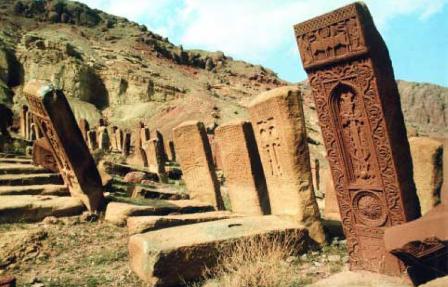
Three years after a cemetery dating back to the 9th Century was deliberately destroyed in the Azerbaijani exclave of Nakhichevan, bloggers recall an ancient culture annihilated and condemn the world for closing its eyes to what many consider to be an official attempt to rewrite history.
Today is the commemoration of the 3rd anniversary of Djulfa’s destruction. …This [is] not only a crime against Armenian culture, but against our collective cultural heritage as humankind. Don’t let it go unnoticed.
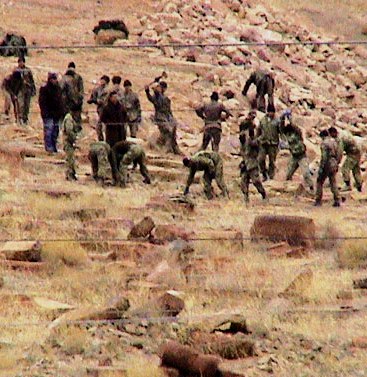
Between 10-16 December 2005 over a hundred uniformed men were videotaped destroying the Djulfa cemetery using sledgehammers, cranes, and trucks. The video was taken from across the border in Iran.
Азербайджанские власти на протяжении всего советского периода старались уничтожить этот некрополь, поскольку для них он был всего лишь свидетельством о том, что именно армяне были хозяевами этой территории на протяжении веков, вопреки тому, что говорилось в азербайджанских советских мифах о собственной “древности”… Это кладбище, вполне достойное названия чуда, было даже не внесено в реестр архитектурных памятников Азербайджана… После распада СССР, во время карабахского конфликта, продолжалось разорение кладбища, и, наконец, оно было окончательно уничтожено….
The Azeri authorities throughout all Soviet period tried to destroy this necropolis as for them it was only a testament that Armenians were owners of this territory throughout centuries in spite of Azerbaijan’s Soviet myths about own “antiquity”… This cemetery, quite worthy to be called a wonder, was not even placed on the register of architectural monuments of Azerbaijan… After USSR’s collapse, during the Karabakh conflict, the cemetery’s demolition continued, and, at last, definitively destroyed….
آنان از سنگ قبر ارامنه هم نگذشته اند و با تخریب دوازده هزار قبر با سنگ قبر هایی منحصر به فرد که متعلق به چند قرن پیش بوده و جزئی از میراث فرهنگی ارامنه به حساب می آمد، هیچ اثری از ارمنی نشین بودن آنجا، بجا نگذاشته اند.
[After acquiring Nakhichevan, Azeris] did not even tolerate Armenian gravestones. They destroyed twelve thousand Armenian graves. These unique gravestones with several centuries’ history were part of Armenian cultural heritage. However, through destruction of these gravestones, [Azeris] destroyed all signs indicating the existence of Armenians in that land. [translated by Loosineh M.]
iArarat, remembers Djulfa by discussing Robert Bevan’s The Destruction of Memory: Architecture at War, a book that was “part of a class I teach at a Texas university on nationalism and ethno-political conflicts.”
[…]
While reading Bevan’s book I was inevitably reminded of the destruction of the medieval Armenian cemetery in Jugha, presently in Azerbaijan. Azeri soldiers at the command of their superiors without as much as blinking an eye would embark at destroying and erasing the last vestige of the Armenian civilization in that territory as if the Armenians had never as much as existed there, as if Armenians had never as much as created anything, something to celebrate their faith and commemorate their dead…
Adding insult to injury, earlier this month Baku, Azerbaijan hosted a little-noticed two-day conference of Council of Europe culture ministers to discuss “Intercultural dialogue as the basis for peace and sustainable development in Europe and its neighboring regions.” In his opening remarks to the attendees Azeri president Ilham Aliyev, astonishingly claimed:
“Azerbaijan has rich history and the cultural monuments here are duly preserved, and a lot is being done in this direction…”
Meanwhile, nrbakert_tashuk [Ru] asks whether one should laugh or cry at attempts to represent other indigenous Armenian monuments as Turkish or Azerbaijani. However, Kornelij [RU] says Armenia is also to blame for not participating in a conference held early this month in the Azerbaijan capital, Baku.
[T]he Armenian Ministry of Culture failed to deliver a message by boycotting the conference. They either should have properly boycotted the conference by making an appropriate statement explaining the reasons for non-participation, or they should have participated there to raise the all important issues of destruction of Armenian cultural heritage in Azerbaijan, as well as protecting and restoring the multinational cultural heritage in all three South Caucasus countries [Armenia, Georgia, and Azerbaijan].
old-dilettante [RU], says that Djulfa’s destruction was the last stage of Azerbaijan’s attempt to eradicate Nakhichevan’s Armenian heritage. Commenting on a post about churches in Georgia, she writes:
Теперь там не найдется ни одной армянской церкви, несмотря на фотографии и книги, изданные всего ничего – лет 20 тому назад. Все церкви уничтожены. Все могилы. Все хачкары.
И кто через 20 лет скажет, что там вообще жили армяне? … А ведь мой дед был “местным жителем”.
…Now, not a single Armenian church will be found [in Nakhichevan] despite of photographs, some as recent as 20-years-old. All churches are annihilated. All cemeteries. All khatchkars.
And who will say in 20 years that Armenians ever lived there? … It wasn’t that long ago that my own grandfather was a “local” there.
Also recalling family history, Washington-based Armenian journalist Emil Sanamyan, a native of Azerbaijan’s capital Baku, commemorates the destruction of Djulfa.
In Baku Armenian cemeteries with less historical but more immediate sentimental value to many (including my family whose three generations made their home in Baku for nearly a century) were paved over for roads or new construction. That does not justify the disrespect they were afforded but makes some remote sense.
In the case of Jugha khachkars stood in the middle of nowhere and were simply crushed, dismembered, thrown into the river. They were targeted and wiped out as the last remaining Armenian outpost.
Sarcastically, the journalist-blogger considers how other Armenian monuments on Azerbaijani territory could be protected.
Now I am thinking, perhaps Armenians should disassemble the remaining Azeri mosques and gravestones on their territory and exchange them for the khachkars and other Armenian heritage items of value?
Certainly some of the Azeri items have cultural value for Armenia and I would rather not see them go. But what other options are there?
Reacting to a comment on his above-mentioned post, Ivan Kondratiev [RU] also says that if Azerbaijanis wanted to cleanse their territory of Armenian heritage, they could have at least given the monuments to Armenia even if such a transfer would amount to acknowledging Djulfa’s Armenian history.
Is the world willing to confront deliberate destruction of historic monuments? In her long post on Djulfa’s destruction, The Stilettosees hope in an Obama administration.
[T]here is reason to be optimistic that [Barack Obama’s] foreign policy team will… have a very different response to the ongoing stonewalling by the Azeris than [current US Secretary of State] Rice’s utter disinterest [about Djulfa’s destruction], which is rooted in the Bush administration’s pro-Azerbaijani, pro-Turkey foreign policy.
In addition to secretary of state nominee Hillary Clinton […] prospective U.N. Ambassador Susan Rice has a particular interest in genocide and is an advocate of military action to stop mass killings, rather than ineffective “dialogue” as slaughters continue apace. And Harvard professor Samantha Power, author of “A Problem from Hell: America and the Age of Genocide” (2002), has been quietly advising Obama behind the scenes […].
Given that past is prologue, with these women’s combined emphasis on championing human rights and genocide prevention, it will not be easy for the Obama administration to ignore or overlook the genocide that preceeded – and encouraged – all others in the 20th and 21st centuries, or the ongoing “cultural genocides” in Azerbaijan and Turkey against the archeological remains of a once-thriving, centuries-old Armenian population that is no more.
More photographs of the cemetery, before and after its destruction, are available at www.djulfa.com.
While most people know Samantha Power as an Obama adviser who has called Hillary Clinton a “monster,” many genocide awareness and prevention activists consider the Harvard professor a hope they can believe in. The Associated Press has noticed that Power, who officially resigned from Obama’s campaign during the Democratic primaries, is on US President-elect Obama’s transition team. This news has encouraged several Armenian bloggers who now feel assured that the author of “A Problem from Hell: America and the Age of Genocide” (2002) will remind President-elect Barack Obama to keep his promise of officially recognizing the WWI Armenian Genocide committed by Ottoman Turks.
[…]
Back with Obama, Power has reignited hope among many Armenians. But some have wished for more. Joseph at the ArmenianGenocide forum:
Samantha Power is back on the Obama team and will be working at the State Department. This is good for Armenians, as she will give a direct challenge to Hillary Clinton { Hillary WILL betray us} and will be a honest broker in a institution where honesty and integrity is a very rare commodity. Still, would have loved to have Samantha Power as our Sec. of State.
John Hughes, editor of ArmeniaNow, writes a moving column expressing his feelings about Barack Obama’s historic victory:
When, at 8:01 a.m. Wednesday in Yerevan, the television I’d been psychically tethered to all night announced that Barack Obama had been voted the next President of the United States, the image in my head replaced the broadcast on CNN with footage of a childhood that added relevance to the vast historicity of the moment.
Tow-headed and not yet mindful that a world existed outside the narrow one in which I toddled, I stood on a stool in an Alabama public square to drink from one of two water fountains. Turns out that the one I’d chosen for refreshment from the summer heat was marked “Colored”. Had I known, I’d have stepped to the “Whites Only” bubbler. Children don’t know. Bless them.
Laughing, pointing and notifying my parents of their youngest’ violation of custom and law my older brother and sister shamed me for reasons that still baffle me. I’d picked the fountain designated for Negroes. For me, it was just a cool drink.
In that year, the man I happily now call MY president, was born far from Alabama prejudice, and closer to the heart of whatever is right in this world whether there or here.
And when, from the home state of Abraham Lincoln, President-elect Obama addressed the divided nation I have left behind for this developing nation, his message referenced the most famous speech of his hero and mine: “. . . we will get there . . . ”
It is a speech I memorized for a high school project in public speaking, but did not practice aloud for fear that I’d be overheard in a household where Martin Luther King Jr. was a devil, and a future in which a Barack Obama fulfilling Rev. King’s vision was not only inconceivable but horrifying.
It was a world that put me at odds with every form of authority to which I was subjected, whether parent, teacher or sports coach. A minister I idolized in the church I attended told me, earning laughs from those around him: “I’m not prejudiced. I just don’t like niggers.”
It shouldn’t have surprised me, then, when tears welled in my eyes as with those on that CNN broadcast, on realizing that the America that taught me to look beyond the reality of my environment had delivered a dream for an apparently deserving servant and his beautiful and elegant family.
I watched Michelle Obama embrace Vice-President elect Joe Biden, and recalled that for most of my childhood, it was forbidden for American TV to show a white person and black person kissing.
Barack Obama is not America’s right choice because he is black. Nor is celebration of his achievement reserved only for the African-American community. Without white voters, Hispanic voters, Asian voters, Native American voters, this son of Kansas and Kenya would have been another history footnote rather than history maker.
The election of this new American president, beyond all the dangerously Pollyanna reactions to the moment (including mine), represents far more universal ideologies than race or nationality or age or gender. Profoundly simplistic, yes, the November 4 American election revived belief that should not be owned by Americans only.
Listening to Barack Obama’s graciously reserved acceptance speech, I heard a message for my new Armenian wife, whose hope of a better Armenia gets crushed again and again each time an election here goes wrong. I heard a message for my new Armenian children – about the same age as the Obama daughters:
Give democracy and human decency a chance, and a way will be found to fulfill your aspirations.
As an Alabama child I saw dogs released on those whose sacrifice made a way to Barack Obama’s stage in Chicago’s Grant Park, and watched TV coverage of white firemen blasting black protestors with blistering water hoses. In this new home of my middle age, I have seen water cannons turned on those who – for reasons other than race – sought change in this society; have heard minorities of every stripe cursed for either their color, their sexual persuasion, or their ethnicity, among these people who should know better than most the evil of ignorance-based hate.
Whether in the Alabama of my youth or in this Armenia of my current reality caught between socialism’s failures and democracy’s promises; wherever discrimination and doubt muffle the heartbeat of hope, the election of Barack Hussein Obama turns campaign jingo into a dogma that I wish these children of mine to realize, as did I, in the early Wednesday Armenia hours: “Yes. We Can”.
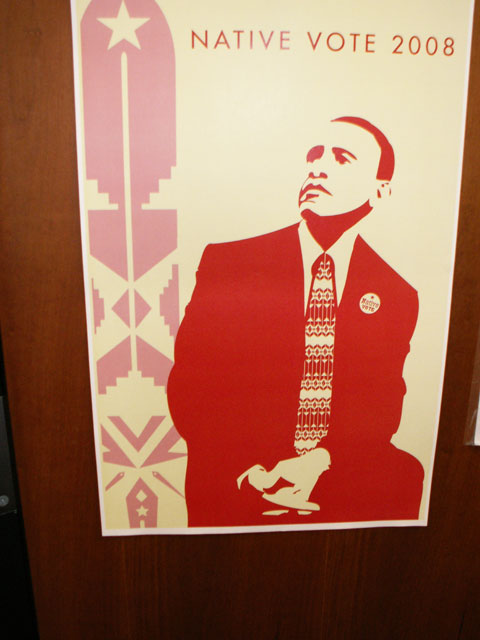
Image: A poster on University of Colorado Denver Professor Glenn Morris’ door.
While Native Americans are United States citizens, they are also considered part of the Fourth World – the Earth’s often invisible indigenous peoples. In a way, Native Americans don’t have much voice in the United States. That’s largely because the “one person, one vote” form of democracy doesn’t always adequately reflect the ideas of the aboriginal people who didn’t really give consent to become part of the United States. But in 2008, Native America seems excited about the US elections more than ever.
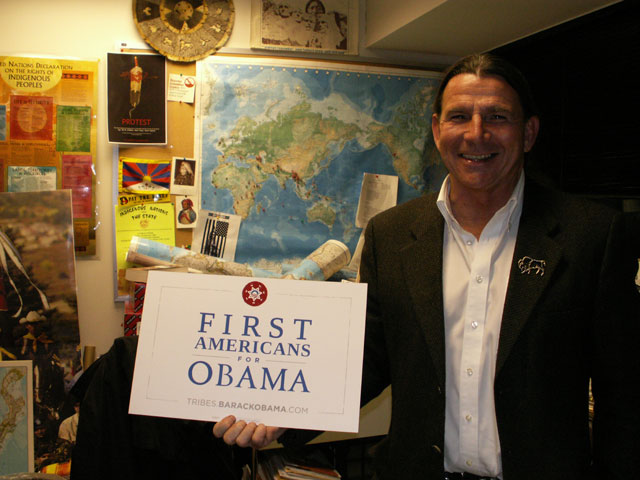
I interview Prof. Glenn Morris, a long-time American Indian Movement (AIM) activist and director of the Fourth World Center at the University of Colorado Denver a day after the election.
Morris, who received his law degree from Harvard several years before president-elect Barack Obama did, seems cautiously excited about the next leader of the United States. The indigenous professor says he is happy that he has been proven wrong about his prediction that racism wouldn’t let Obama get elected. He’s worried, though, about false perception of overcoming racism.
Image: Prof. Glenn Morris at the Fourth World Center (University of Colorado)
“My concern has been the tendency to suggest that Obama’s election demonstrates a post-racial era. The danger of defining race as black and white allows the United States to ignore the country’s original sin – the Doctrine of Discovery.” Morris says that racism will be prevalent until the country “looks at the foundational injustice in the creation” of the United States, with a reference to the genocide against Native Americans.
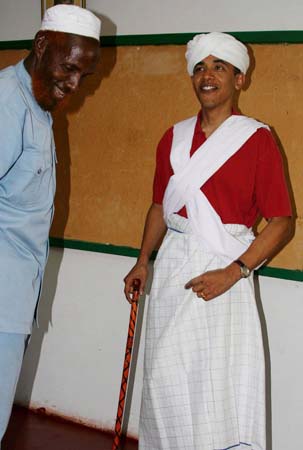
Image: Obama in an indigenous Kenyan dress
The professor says that there are different Indian voices in the elections. But the Navajo nation, explains Morris, had a role in delivering Mexico (and almost Arizona) for Obama. And while the restless activist says he’s excited about Obama’s idea to have a presidential adviser on Native American issues, he hopes that “Native participation will translate into policy.” In Canada, for instance, the federal government often makes decisions affecting aboriginal communities by consulting with First Nations. Morris thinks that consent, not consultation, should be the level of such communication.
Was the Native vote numerically or symbolically important for Barack Obama? Morris says Obama’s outreach to Americans Indians was “partly personal, partly ideological, and partly tactical.”
Obama “may not understand [Native American issues] entirely,” says Glenn Morris, but America’s 44th president seems the only leader so far “who may kind of get it.”
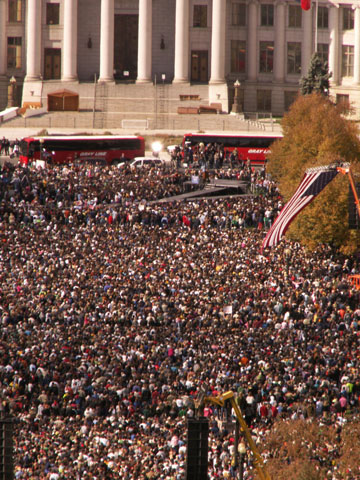
Photo: Obama’s largest campaign rally in Denver, Colorado, on October 26, 2008
Today I took my Mom to a Lady’s Night at an Armenian friend’s house in Boulder, where in lieu of birthday presents the host had asked guests to donate to the Barack Obama campaign on her personalized page. Although not a citizen just yet, this was not the first time my Mom made a donation to the Obama campaign. In fact, proportionally speaking, she is perhaps a top Obama donor.
While sometimes it feels that to be part of the “real Armenian community” in the United States one needs to live in Southern California, actually right now Colorado is the Armenian-American political center – at least through Tuesday.
I learned from local Armenian-American volunteers for the Obama campaign that there are approximately 3,000 registered voters with “ian” and “yan” last names (the common ending of Armenian names) in Colorado, a swing state. This basically means that Armenian-Americans in Colorado could decide the U.S. elections.
Alaska, America’s 49th state where the current Republican vice presidential nominee hails from, and Armenia, a country the Obama-Biden ticket is vibrantly supportive of, have something in common – they are both a heartbeat away from Russia.
The Republican ticket’s not-so-profound support for Armenian causes aside, one wonders about even the awareness of such issues in the ticket. Senator McCain, who has been to Armenia, is definetly aware of issues that concern Armenian-Americans. But what about Governor Palin? Does she even know if such a country exists?
According to The National, Sarah Palin does know at least one Armenian-American. Here is the latter’s story:
[…]
Andrée McLeod is shouting into the phone from a desk set up in her bedroom as I wait for her at a kitchen table annexed by stacks of paper. “She’s only powerful if you think she is! This right here, if it turns out to be true, is a bunch of bull****!”
It is because of McLeod, a lovably obstreperous woman of Armenian descent somewhere in her fifties, that the world knows of Governor Palin’s preference for Yahoo over .gov – one of the little details from Alaska that suggest uncomfortable parallels between the modus operandi of the Palin State House and the Bush White House, which also liked to transact government business on private e-mail accounts.
The stacks covering the table are the fruits of McLeod’s request for e-mails and phone calls between Palin and two aides, whom McLeod suspected of working in concert to oust the Alaska Republican Party chair, Randy Ruedrich – a violation of the state executive ethics code, which forbids conducting party business on state time. It might seem a venial sin – but it was also precisely the accusation Palin had earlier wielded to eject Ruedrich from the Alaska Oil and Gas Conservation Commission– with the help of Andree McLeod herself.
McLeod emigrated from Beirut with her family in 1963, and moved to Alaska from Long Island thirty years ago. She was apolitical until 1995, when she spied an opportunity to earn money for grad school by operating a falafel cart in Anchorage. The town fathers squashed her plans, declaring fried chickpeas “potentially hazardous.” She took the fight to city hall, wound up running for mayor, and her local state house seat twice, losing the last time in a tight race that required a recount.
McLeod told me that she’d met Palin shortly after her own failed state house bid in 2002. They’d stuck up an unlikely friendship, the home-grown beauty queen and the cerebral but scrappy and energetic import. Palin complained to McLeod about Ruedrich’s penchant for doing party work from his office at the AOGCC, where Palin also served – appointed by Murkowski after her losing bid for Lt. Governor marked her as a “comer” in the state party. McLeod got tired of Sarah’s ceaseless complaints and told her to do something about it already.
“She didn’t know how to go about it,” McLeod says. “I would guide. So that reporters would ask her, but there was a role I played in the background, making sure all the information was correct. But she did the exact same thing she accused Randy of doing. Had I known that I wouldn’t have given her the time of day.”
The takedown of Randy Ruedrich was Palin’s first public scalping (of a fellow Republican, no less) and it helped cast her as a dogged reformer.
“It’s true, Andrée’s almost responsible for creating Sarah Palin,” Rick Rydell, an Anchorage talk radio host and 2004 Alaska Republican Man of the Year, tells me over sushi a few days later. Rydell has just finished his show, which airs weekdays from six to nine in the morning. His Harley is parked out front and we’re sampling some hijiki and gyoza, talking about the Palinistas – his disparaging moniker for those still “drinking the kool-aid.”
[…]
By the end of the week, my family and friends around the world won’t ask me “where is it?” when I tell them I live in Denver.
In a few hours, the Democratic National Convention will start in a city that last year had over 12 million overnight visitors. Still, Denver is not, yet, as famous as New York, Chicago, Dallas or Los Angeles.
But with its beautiful architecture and nature, Colorado’s capital and largest city Denver will quickly win hearts. The nearby Red Rocks, the beautiful State Capitol (where I work), yummy restaurants and cozy bars offer locals and visitors exceptional pleasure and leisure.
Dating back to 1858, Denver is a century and a half old. It became the state capital after Golden and Colorado City lost their bid. It was a simple decision – Denver had more women than any other city in the state.
More women – more rights. In 1893, women in Colorado won their right to vote – only the second in the nation. In 1894, three women were elected to serve in the House of Representatives. Before them, no woman had served as a senator or representative anywhere else in the United States.
In 1908, when the Democratic National Convention met in Denver for the first time, women were allowed to be delegates at the convention for the first time. It wasn’t until 1920, though, when the federal government extended the right to vote to all women.
Along with progressive history, Colorado has darks sides too. In 1864, Colorado volunteers (who thought they were fighting in the Civil War) exterminated an entire peaceful camp of Native Americans at Sand Creek. And in the 1920s, Colorado’s governor was a member of the Ku Klux Klan.
With a diverse history, Colorado isn’t ethnically very diverse. Denver is the exception, where along with white Americans you will see Americans from all races and of all countries. Perhaps this diversity is what makes Denver so hospitable. Hospitality in Denver is almost as good as in Armenia.
Speaking of Armenians, many people get surprised when they find a quarter-century-old Armenian Genocide monument-plaque at the Colorado State Capitol. And although the Armenian community is not very large (perhaps 4,000 in and around Denver), its roots are very old.
Once I came across to a January 27, 1884, article in the local Rocky Mountain News. It talked about four Armenians, originally from what is now eastern Turkey, who had come from Italy. In Denver, they had become merchants. But in their hearts, they had always stayed Armenians and dreamed of returning to their homeland. Their hope was to return to Armenia: “My brother feels as I do, that in our own beautiful land in Asia Minor lies our destiny and it may be that near our old home we shall find at last the ancient site of Eden.”
Had they returned to Armenia, they would have been killed either in the Hamidian massacres or in the Genocide of 1915. I don’t know if they returned or not.
A number of Armenian friends – many of them with the media – are visiting Denver for the Convention this week. Voice of America is planning to interview local Armenians and guests.
I learned from the U.S. Embassy last month that Armenia had two-member delegation traveling to Denver for the Democratic National Convention.